Quotessence
Home / Quotes / Quote by Sappho

Quote by Sappho

“Some say cavalry and others claim infantry or a fleet of long oars is the supreme sight on the black earth. I say it is the one you love. And easily proved. Did not Helen, who far surpassed all in beauty, desert the best of men her husband and king and sail off to Troy and forget her daughter and dear parents? Merely love's gaze made her bend and led her from her path. These tales remind me now of Anaktoria who is gone. And I would rather see her supple step and motion of light on her face than chariots of the Lydians or ranks of foot soldiers in bronze. Now this is impossible yet among the living I pray for a share and unexpectedly”

Quote by Sappho

Author
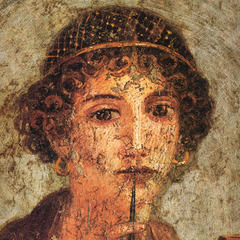
Sappho
Sappho

Sappho, a renowned lyric poet from ancient Greece, lived from 625 BC to 571 BC. She is celebrated for her emotional and lyrical poetry, which has had a profound impact on the history of Greek literature. Sappho's works primarily consist of lyric poems, encompassing themes of love, nature, and philosophy, and she is considered a pioneer of lyric poetry in ancient Greece. more

You May Also Like

“Helen, your sinful deeds brought a bitter end to Priam and his lovely children. They say because of you holy Ilium was destroyed by climbing fire. But the son of Aiakos did not find such a wife when he summoned the blessed gods to his wedding and took the delicate sea nymph Thetis from the watery palace of Nereus, bringing her to the mountain cave of the centaur Cheiron. There, the love of Peleus for his sea-nymph led him to lie naked with the untouched virgin, and within the year she bore a son, Achilles; bravest demigod and splendid driver of tawny stallions. But for Helen, Ilium and her people were destroyed.”

“Only emptiness and nothingness can provide space to the world; chance is the uniting force of the Being and the Nonbeing. If we view evolution in this context, evolution, as selection, is no longer a random selection or Herbert Spencer’s “survival of the fittest” but the survival of existence itself. Whatever survives is thanks not only through combinations and recombination of some otherwise self-organized dead matter, self-powered peculiarly through an infinite series of accidents, but rather through an infinite series of predetermined chances. Determinism is based more on chance than on determination. A determined chance is not a chance, strictly speaking. This chance is not chaotic and random. The chance is more orderly than a lack of chance. The chance gives rise to a more deterministic world regarding purpose, meaning, and destiny. Destiny is the purpose of determination. But destiny, as all else discussed, is not necessarily determined. What is determined is that there should be existence, purpose, and meaning. From the point of view of purpose and meaning, the best possible existence is the existence responsible for its own becoming through chance.”