“Holding a precious book meant to Mendel what an assignment with a woman might to another man. These moments were his platonic nights of love. Books had power over him; money never did. Great collectors, including the founder of a collection in Princeton University Library, tried in vain to recruit him as an adviser and buyer for their libraries—Jakob Mendel declined; no one could imagine him anywhere but in the Café Gluck. Thirty-three years ago, when his beard was still soft and black and he had ringlets over his forehead, he had come from the east to Vienna, a crook-backed lad, to study for the rabbinate, but he had soon abandoned Jehovah the harsh One God to give himself up to idolatry in the form of the brilliant, thousand-fold polytheism of books. That was when he had first found his way to the Café Gluck, and gradually it became his workplace, his headquarters, his post office, his world. Like an astronomer alone in his observatory, studying myriads of stars every night through the tiny round lens of the telescope, observing their mysterious courses, their wandering multitude as they are extinguished and then appear again, so Jakob Mendel looked through his glasses out from that rectangular table into the other universe of books, also eternally circling and being reborn in that world above our own.”
Quote by Stefan Zweig
Work
The Collected Stories of Stefan Zweig
Browse quotes and source details for this work. more
Author
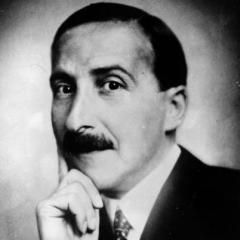
Stefan Zweig
Stefan Zweig, born on November 28, 1881 in Vienna, was an Austrian novelist, playwright, and biographer. Known for his profound psychological insights and unique narrative style, he is a significant figure in European literature at the beginning of the 20th century. more
You May Also Like
Source: Far Away and Long Ago: A History of My Early Life
Source: The Midnight Disease: The Drive to Write, Writer's Block, and the Creative Brain
Source: Waiting for Sunrise
Source: Sympathy
Source: The Answers
Source: الحالم يستيقظ
“I would fight of course. Oh, I would fight. Better destroy everything than surrender her.”
Source: Lolita
“Let go into His arms untill you find yourself obsessed with things devine”
Source: The Ecstasy of Loving God