Quotessence
Home / Quotes / Quote by Louisa May Alcott

Quote by Louisa May Alcott

“He wanted Jo for his heroine, and called upon his memory to supply him with tender recollections and romantic visions of his love. But memory turned traitor, and as if possessed by the perverse spirit of the girl, would only recall Jo's oddities, faults, and freaks, would only show her in the most unsentimental aspects – beating mats with her head tied up in a bandana, barricading herself with the sofa pillow, or throwing cold water over his passion a la Gummidge – and an irresistable laugh spoiled the pensive picture he was endeavoring to paint. Jo wouldn't be put into the opera at any price, and he had to give her up with a 'Bless that girl, what a torment she is!' (...)”

Quote by Louisa May Alcott

Work

Little Women

Set in the mid-19th century, this enduring tale follows the adventures and challenges of Meg, Jo, Beth, and Amy March, four sisters from a modest New England family. The narrative explores themes of love, loss, and the pursuit of individual dreams amidst the backdrop of a turbulent period in American history. more

Author

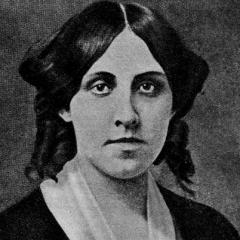
Louisa May Alcott
Louisa May Alcott

American novelist, famous for works such as 'Little Women'. Born on November 29, 1832, and died on March 6, 1888. more

You May Also Like

“An unliterary man may be defined as one who reads books once only. . . . We do not enjoy a story fully at the first reading. Not till the curiosity, the sheer narrative lust, has been given its sop and laid asleep, are we at leisure to savour the real beauties. Till then, it is like wasting great wine on a ravenous natural thirst which merely wants cold wetness.”

“Behind these practical studies lay powerful, intertwined, and potentially contradictory beliefs: that language provides a key to the rational, scientific understanding of the world and that language is more than human speech, that it claims a divine origin and is the means by which God created the cosmos and Adam named the beasts. As we will see, both ideas strongly influenced the Inklings, whose leading members wrote many words about the meaning of words. For Owen Barfield, language is the fossil record of the history and evolution of human consciousness; for C. S. Lewis, it is a mundane tool that "exists to communicate whatever it can communicate" but also, as in That Hideous Strength, an essential part of our metaphysical makeup for good or ill; for Charles Williams, language is power, a field of force for the magician, a vehicle of prayer for the believing Christian; for Tolkien, language is a fallen human instrument and a precious divine gift ("O felix peccatum Babel!" he exclaimed in his essay "English and Welsh"), a supreme art, and, as "Word", a name for God.”

“Christopher Westcott slowly drank his pint of ale at the Bird and Baby, as locals liked to call the Eagle and Child, and basked in the familiar smells- old wood bathed in lemon oil, braised beef, stale beer that spackled the bar. The pub was a popular mecca for those who admired J.R.R. Tolkien, C.S. Lewis, and their entire literary giants they called Inklings. Christopher wasn't even close to being a literary giant nor was he a tourist, but he enjoyed writing and liked to feign himself one of the professors who might have basked in the lively readings and debates of the Inklings instead of just the aromas of this pub. Personally, he admired the writings of George MacDonald, the man C.S. Lewis considered his mentor. MacDonald was a writer and professor. And he was a frequently unemployed Scottish minister due to his views on God's love and grace. The man could speak the language of theologians at the same time he wrote books for children and readers of all ages whom he described as "child-like, whether they be of five, or fifty, or seventy-five." MacDonald was a man of integrity who believed that God did not punish His children except to amend and heal them. A man who believed God's love and grace was available to all people- a direct affront to the Calvinists in his era.”