Quotessence
Home / Quotes / Quote by Stephen Hawking

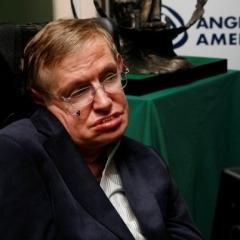
Quote by Stephen Hawking

“WE EACH EXIST FOR BUT A SHORT TIME, and in that time explore but a small part of the whole universe. But humans are a curious species. We wonder, we seek answers. Living in this vast world that is by turns kind and cruel, and gazing at the immense heavens above, people have always asked a multitude of questions: How can we understand the world in which we find ourselves? How does the universe behave? What is the nature of reality? Where did all this come from? Did the universe need a creator? Most of us do not spend most of our time worrying about these questions, but almost all of us worry about them some of the time.”

Quote by Stephen Hawking

Work

The Grand Design

Browse quotes and source details for this work. more

Author

Stephen Hawking
Stephen Hawking

Stephen Hawking was a renowned British theoretical physicist known for his contributions to the fields of black hole theory and cosmology. Born on January 8, 1942, he overcame the challenges of ALS to become a global icon of science and perseverance. more

You May Also Like

“To understand the universe at the deepest level, we need to know not only how the universe behaves, but why. Why is there something rather than nothing? Why do we exist? Why this particular set of laws and not some other?” “This is the Ultimate Question of Life, the Universe, and Everything. We shall attempt to answer it in this book. Unlike the answer given in The Hitchhiker’s Guide to the Galaxy, ours won’t be simply “42.”

“In the history of science we have discovered a sequence of better and better theories or models, from Plato to the classical theory of Newton to modern quantum theories. It is natural to ask: Will this sequence eventually reach an end point, an ultimate theory of the universe, that will include all forces and predict every observation we can make, or will we continue forever finding better theories, but never one that cannot be improved upon? We do not yet have a definitive answer to this question, but we now have a candidate for the ultimate theory of everything, if indeed one exists, called M-theory. M-theory is the only model that has all the properties we think the final theory ought to have, and it is the theory upon which much of our later discussion is based. M-theory is not a theory in the usual sense. It is a whole family of different theories, each of which is a good description of observations only in some range of physical situations.”

“Though we feel that we can choose what we do, our understanding of the molecular basis of biology shows that biological processes are governed by the laws of physics and chemistry and therefore are as determined as the orbits of the planets. Recent experiments in neuroscience support the view that it is our physical brain, following the known laws of science, that determines our actions, and not some agency that exists outside those laws. For example, a study of patients undergoing awake brain surgery found that by electrically stimulating the appropriate regions of the brain, one could create in the patient the desire to move the hand, arm, or foot, or to move the lips and talk. It is hard to imagine how free will can operate if our behavior is determined by physical law, so it seems that we are no more than biological machines and that free will is just an illusion.”

“If the total energy of the universe must always remain zero, and it costs energy to create a body, how can a whole universe be created from nothing? That is why there must be a law like gravity. Because gravity is attractive, gravitational energy is negative: One has to do work to separate a gravitationally bound system, such as the earth and moon. This negative energy can balance the positive energy needed to create matter, but it’s not quite that simple. The negative gravitational energy of the earth, for example, is less than a billionth of the positive energy of the matter particles the earth is made of. A body such as a star will have more negative gravitational energy, and the smaller it is (the closer the different parts of it are to each other), the greater this negative gravitational energy will be. But before it can become greater than the positive energy of the matter, the star will collapse to a black hole, and black holes have positive energy. That’s why empty space is stable. Bodies such as stars or black holes cannot just appear out of nothing. But a whole universe can. Because gravity shapes space and time, it allows space-time to be locally stable but globally unstable. On the scale of the entire universe, the positive energy of the matter can be balanced by the negative gravitational energy, and so there is no restriction on the creation of whole universes. Because there is a law like gravity, the universe can and will create itself from nothing in the manner described in Chapter 6. Spontaneous creation is the reason there is something rather than nothing, why the universe exists, why we exist. It is not necessary to invoke God to light the blue touch paper and set the universe going.”

“Why are the fundamental laws as we have described them? The ultimate theory must be consistent and must predict finite results for quantities that we can measure. We’ve seen that there must be a law like gravity, and we saw in Chapter 5 that for a theory of gravity to predict finite quantities, the theory must have what is called supersymmetry between the forces of nature and the matter on which they act. M-theory is the most general supersymmetric theory of gravity. For these reasons M-theory is the only candidate for a complete theory of the universe. If it is finite—and this has yet to be proved—it will be a model of a universe that creates itself. We must be part of this universe, because there is no other consistent model. M-theory is the unified theory Einstein was hoping to find. The fact that we human beings—who are ourselves mere collections of fundamental particles of nature—have been able to come this close to an understanding of the laws governing us and our universe is a great triumph. But perhaps the true miracle is that abstract considerations of logic lead to a unique theory that predicts and describes a vast universe full of the amazing variety that we see. If the theory is confirmed by observation, it will be the successful conclusion of a search going back more than 3,000 years. We will have found the grand design.”

“When I deal with smart IT programmers, I have a strong impression that their job has much in common with the phenomenon of how the Lord arranged the Universe and created genetics (cells, DNA, molecules, etc.). Both genetics and computer programming create their magic by performing highly intelligent coding work.”