Quotessence
Home / Quotes / Quote by George Orwell

Quote by George Orwell

“To know and not to know, to be conscious of complete truthfulness while telling carefully constructed lies, to hold simultaneously two opinions which cancelled out, knowing them to be contradictory and believing in both of them, to use logic against logic, to repudiate morality while laying claim to it, to believe that democracy was impossible and that the Party was the guardian of democracy, to forget whatever it was necessary to forget, then to draw it back into memory again at the moment when it was needed, and then promptly to forget it again: and above all, to apply the same process to the process itself -- that was the ultimate subtlety: consciously to induce unconsciousness, and then, once again, to become unconscious of the act of hypnosis you had just performed. Even to understand the word 'doublethink' involved the use of doublethink.”

Quote by George Orwell

Book:1984

Work

1984

George Orwell's '1984' is a seminal work of literature that explores themes of government control, individuality, and the erosion of privacy. The story is set in a future where the world is divided into three superstates, each engaged in perpetual war. The protagonist, Winston Smith, works for the Ministry of Truth and is disillusioned with the oppressive regime. The novel delves into the psychological and societal consequences of living under constant surveillance and the struggle for truth and freedom. more

Author
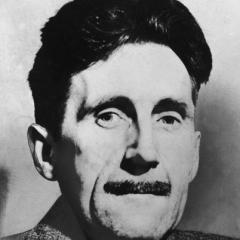
George Orwell
George Orwell

George Orwell, born Eric Arthur Blair, was a British novelist and political critic. Known for his sharp social criticism and profound insights into totalitarianism, Orwell is best remembered for his novels '1984' and 'Animal Farm', which remain influential to this day. more

You May Also Like

“If I lived anywhere else for the sheer love of it, it would only be farther and farther north, chasing the boreal up to the Yukon or the Northwest Territories. There’s something about living beside a great stretch of forest, both as participant and as witness, that is endlessly absorbing, at once enchanting and distressing. The former because there are vistas and qualities of light in the spaces of the everyday that are otherworldly, requiring an absolute halting of all activity and an undivided attention to just that light at that time. The latter because there is an incredible amount to learn to feel as though you have some small right to be here, holding fast on the patch of ground you stand on.”

“I won’t wax poetic about the land in a perfectionist sense: we work hard out here, and things constantly threaten the tiny equilibrium we’ve established in the market garden. Whatever peace we find is often hard won. But I stand firmly with Berry and Kingsolver and so many other writers who possess a deep need to step outside the city to find a place of calm. I don’t like the word “authentic”; at best, it’s divisive and antagonistic, implying one way of being is intrinsically better than another. But I do very much favour the notion of alignment. I’m convinced that at the heart of the matter lies a desire to draw what we do into alignment with how we live. Some of us aren’t in a place where we can live consistently on the land that holds our hearts, but come mishaps or miracles, we’re bound and determined to make that land as much a part of who we are as humanly possible.”

“It doesn’t take a farm to invoke the iron taste of leaving in your mouth. Anyone who loves a small plot of ground — a city garden, a vacant lot with some guerilla beds, a balcony of pots — understands the almost physical hurt of parting from it, even for a minor stint. I hurt every day I wake up in our city bed, wondering how the light will be changing over the front field or across the pond, whether the moose will be in the willow by the cabin again, if the wren has fledged her young ones yet and we’ll return to find the box untended. I can feel where the farm is at any point in my day, not out of some arcane sixth sense developed from years of summer nights out there with the coyotes under the stars, but because of the bond between that earth and this body. Some grounds we choose; some are our instinctive homes.”

“A man or woman who travels in the end will never be kept. But if you understand that person well enough, they’ll always be by your side. They might have forgotten where their home is in this world - but you might just make them feel like the closest thing to feeling at home. And while they’ll be leaving country after country, this is the way you will never leave their heart.”