Quotessence
Home / Quotes / Quote by Albert Camus

Quote by Albert Camus

“The only picture of Tarrou he would always have would be the picture of a man who firmly gripped the steering-wheel of his car when driving, or else the picture of that stalwart body, now lying motionless. Knowing meant that: a living warmth, and a picture of death.”

Quote by Albert Camus

Author
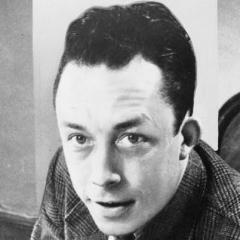
Albert Camus
Albert Camus

Albert Camus was a French author and philosopher, born on November 7, 1913, and died on January 4, 1960. Known for his unique existentialist philosophy and profound insights into human suffering, Camus' works include 'The Stranger', 'The Plague', and 'The Myth of Sisyphus', which have had a profound impact on 20th-century literature. more

You May Also Like

“I’m not surprised that in a time of hideous precarity so many of us would find ourselves tempted by the false grandiosities of certainty. But we must not confuse certainty with safety — in fact, certainty is the end of the imagination and therefore the definition of unsafety. Nor should we confuse unknowing with ignorance. To unknow is to admit limits, to acknowledge that others might have answers you lack, to recognize our exquisite interdependence as people, and best of all to seek within. To dwell in unknowing is to put your phone away and be for a brief moment completely, imperfectly, human. In times like ours unknowing is excellent proof against our society’s inhumanity, against the lizard supremacy of certainty. There is wisdom in the question deferred, the question without an immediate answer. Tolerance and unity, too. And art, as well, if we can tolerate the fact that we are all forever a question without answers, a beautiful unknown, an infinite unknowing.”

“This strange instrument I think I still have somewhere, for I could never bring myself to sell it, even in my worst need, for I could never understand what possible purpose it could serve, nor even contrive the faintest hypothesis on the subject. And from time to time I took it from my pocket and gazed upon it, with an astonished and affectionate gaze, if I had not been incapable of affection. But for a certain time I think it inspired me with a kind of veneration, for there was no doubt in my mind that it was not an object of virtu, but that it had a most specific function always to be hidden from me. I could therefore puzzle over it endlessly without the least risk. For to know nothing is nothing, not to want to know anything likewise, but to be beyond knowing anything, to know you are beyond knowing anything, that is when peace enters in, to the soul of the incurious seeker. It is then the true division begins, of twenty-two by seven for example, and the pages fill with the true ciphers at last.”