Quotessence
Home / Quotes / Quote by Rabindranath Tagore

Quote by Rabindranath Tagore

“Our music draws the listener away, beyond the limits of everyday human joys and sorrows, and takes us to that lonely region of renunciation which lies to the root of the universe, while European music leads us to a variegated dance through the endless rise and fall of human grief and joy.”

Quote by Rabindranath Tagore

Author
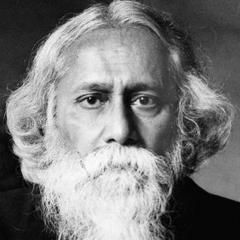
Rabindranath Tagore
Rabindranath Tagore

Rabindranath Tagore, a renowned Indian poet, writer, philosopher, and social activist, was born on May 7, 1861, in Calcutta, and passed away on August 7, 1941. Tagore's works blend the influences of traditional Indian literature and Western literature, and his poetry, novels, plays, and essays have won the hearts of readers worldwide. He was the first Asian writer to win the Nobel Prize in Literature, and his works have had a profound impact on world literature. more

You May Also Like

“Orvil mainly listens to powwow music. There's something in the energy of that big booming drum, in the intensity of the singing, like an urgency that feels specifically Indian. He likes the power the sound of a chorus of voices makes too, those high-pitched wailed harmonies, how you can't tell how many singers there are, and how sometimes it sounds like ten singers, sometimes like a hundred.”

“There is a curious idea among unscientific men that in scientific writing there is a common plateau of perfectionism. Nothing could be more untrue. The reports of biologists are the measure, not of the science, but of the men themselves. There are as few scientific giants as any other kind. In some reports it is impossible, because of inept expression, to relate the descriptions to the living animals. In some papers collecting places are so mixed or ignored that the animals mentioned cannot be found at all. The same conditioning forces itself into specification as it does into any other kind of observation, and the same faults of carelessness will be found in scientific reports as in the witness chair of a criminal court. It has seemed sometimes that the little men in scientific work assumed the awe-fullness of a priesthood to hide their deficiencies, as the witch-doctor does with his stilts and high masks, as the priesthoods of all cults have, with secret or unfamiliar languages and symbols. It is usually found that only the little stuffy men object to what is called "popularization", by which they mean writing with a clarity understandable to one not familiar with the tricks and codes of the cult. We have not known a single great scientist who could not discourse freely and interestingly with a child. Can it be that the haters of clarity have nothing to say, have observed nothing, have no clear picture of even their own fields? A dull man seems to be a dull man no matter what his field, and of course it is the right of a dull scientist to protect himself with feathers and robes, emblems and degrees, as do other dull men who are potentates and grand imperial rulers of lodges of dull men.”