Quotessence
Home / Quotes / Quote by Peter Enns

Quote by Peter Enns

“[The Lord's Supper teaches that] Rituals are good, and they are instituted and used by God to 'connect' his people with him. We learn through ritual that the church is not just made up of individuals, but is a corporate body. It is not just about personal salvation, but a group of people, the people of God, who are bound to one another and to the faithful through the generations. (page 263)”

Quote by Peter Enns

Book:Exodus

Work

Exodus

Browse quotes and source details for this work. more

Author

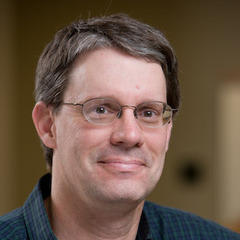
Peter Enns
Peter Enns

Peter Enns is a renowned scholar known for his contributions to the field of religious studies. Born on January 2, 1961, he graduated from Yale University and began his academic career there. Enns' research interests include biblical studies, religious history, and theology. His works have had a wide-reaching impact in the academic community. more

You May Also Like

“One of the things that happened when the church moved from meetings in homes to having purpose-built buildings beginning before, but accelerated during, the Constantinian era, is that while the church itself was becoming less Jewish in character, it began to apply a more and more Old Testament hermeneutic to its discussions about church, ministry, and sacraments. The church began to be seen as a temple or basilica, the Lord’s Supper began to be seen as a sacrifice, and naturally enough the ones offering the sacrifices, just as in Leviticus, were seen to be priests. There was the further move in this direction when Sunday began to be seen as the Sabbath, another example of this same sort of hermeneutic. There were considerable problems with this whole hermeneutic from the start, since nowhere in the New Testament is there set up a class of priests or clerics to administer any sacraments. Indeed, nowhere was there a clear separation between life in the home and life in church. What has often been missed in the discussions of the effects of all this is that it ruled women out of ministry in the larger church and indeed ruled them out of celebrating the Lord’s Supper as well, since in the Old Testament only males were priests and only priests could offer sacrifices.”

“Luther and Calvin believed that both the Roman church on the right and the Zwinglian and Anabaptist churches on the left made the Lord's Supper too much a place WHERE BELIEVERS DID THINGS FOR GOD - either by offering Christ to God (Rome) or by offering their deep devotion to God (the Radical Protestants). The main direction of the Supper, in both of these views, was up.”

“This insistence on a degree of faith in the communicant is also illustrative of Wesley's belief in the necessity for the co-operation of an active faith in man with the gift of God's grace to make the sacrament effective, which is congruent with his whole theology of salvation, with it's blending of the objective and the subjective.”

“The reference in 1 Corinthians 11:27 is to Christ’s actual body, which was crucified, as the reference to blood makes evident. Anaziõs has been translated 'in an unworthy manner,' and sometimes incorrectly thought to modify not the way of partaking but the character of the persons partaking. But Paul refers to those who are partaking in an unworthy manner, not those who in themselves are unworthy, which presumably Paul would see as including any and all believers. No one is worthy of partaking of the Lord’s Supper; it’s not a matter of personal worth. Paul is rather concerned with the abuse in the actions of the participants, or at least some of them. Paul says that those who partake in an unworthy manner, abusing the privilege, are liable or guilty in some sense of the body and blood of Jesus. They are, in addition, partaking without discerning or distinguishing 'the body.”

“Sometimes silences are pregnant and sometimes not. It is hard to know what to make of the silence of much of the New Testament about the Lord’s Supper. Perhaps it is simply an accident of time and circumstance. There was not a felt need to address the matter. What we should not likely conclude is that it was not seen as an important matter in the latter part of the first century A.D. What we can observe is that the Lord’s Supper continued to be an in-home ceremony taken in the context of a fellowship meal. We also now know it was important in both Gentile and Jewish contexts in the church in the second half of the first century, and beyond. We see no evidence anywhere in this material that clerics of any kind are in charge of the meal and its distribution. Even in the Didache, prophets, who were mouthpieces for God, are only allowed to say the thanksgiving prayer as often as they like. The low ecclesiology, coupled with the ever-present eschatology, suggest that the Didache does indeed go back to the end of the first century A.D. But one precedent in the Didache does stand out: the Lord’s Supper is for baptized Christians, and in particular for those who repent of their sins. We are on the way to the church of the Middle Ages in some respects, but we have not begun to localize or confine grace to the elements of the Lord’s Supper itself and then have it controlled by clerics.”

“When exactly did this all change, and what were the social and theological factors that led to the change? The answer seems to be in the second century and: (1) because of the consolidation of ecclesial power in the hands of monarchial bishops and others; (2) in response to the rise of heretical movements such as the Gnostics; (3) in regard to the social context of the Lord’s Supper, namely, the agape, or thanksgiving, meal, due to the rise to prominence of asceticism in the church; and (4) because the increasingly Gentile majority in the church was to change how second-century Christian thinkers would reflect on the meal. Thus, issues of power and purity and even ethnicity were to change the views of the Lord’s Supper and the way it would be practiced.”

“Who should serve the Lord’s Supper? Well in the early church, considering Acts 2 and 1 Corinthians 11, the host of the home presumably was the host of the meal, and as I have said, really, the Lord is the host at his own table, not any of us. We are all just participants, we are all celebrants. I don’t think there is any biblical warrant for the serving of the Lord’s Supper to be confined to ministers, but I do think that anyone who undertakes such a sacred task should be trained to do it in a respectful manner.”

“Despite the differences in detail and in emphasis in Wesley's exposition of the two sacraments, there is an underlying unity in his sacramental theology. He regarded both sacraments as means whereby God could confer grace according to His promise, but yet insisted, that in order to prevent the means from being mistaken as ends, it was necessary for there to be an appropriation of the grace held out by the faith of the believer. Grace was not conferred IN SPITE OF MAN, but only with his co-operation. So human response was necessary for the efficacy of the sacraments, although man's actions were never thought of as meritorious works.”