Quotessence
Home / Quotes / Quote by Saint Augustine

Quote by Saint Augustine

Author

Saint Augustine
Saint Augustine

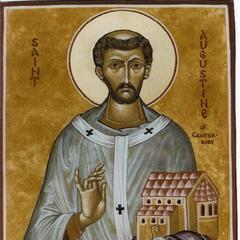
Saint Augustine, born on November 13, 354 in Tagaste, North Africa, and died on August 28, 430, was an influential Christian theologian, philosopher, and writer. He is considered one of the 'Fathers of the Church' and had a profound impact on Christian theology, philosophy, and Latin literature. His work 'Confessions' is a classic of Western literature, and his thoughts have had a lasting influence on Christian doctrine and Western culture. more

You May Also Like

“Descending south into St. Augustine’s Historic District along A1A, visitors are immediately confronted by an edifice which serves as a stark reminder that the city was originally founded as a military outpost, deep in hostile territory. Jutting up like a molar from the defensive teeth of the Ancient City is the forbidding fortress of Castillo de San Marcos, a coquina fortification which has served many roles it its nearly three hundred fifty year history.”

“In esoteric traditions, such conceptual schemes are considered a function of conditioning, not an inherent part of what is. Nonduality abides no contrast or comparison, no distinction between this and that, and no sequence of before and after. Beneath the surface play of phenomena, there is a formless, undifferentiated realm invisible to the naked eye; devoid of all parts, there remains only the unceasing flow and energy of life. Any concept of the Divine, therefore, is misleading, as it stands in the way of the deepest insights into the nature of reality. "God" is a concept, and, as such, is considered a misguided attempt to capture the infinite in the finite--to limit that which is limitless. As Mariana Caplan points out, "it is our imagination of God that fails," not God who fails us. St. Augustine voiced the same insight sixteen hundred years ago when he said God was not what we imagine or think we understand.”

“Enslaved people began to flee harsh conditions in Virginia and South Carolina to Spanish Florida [in the 1680s]. If an enslaved person made it there and professed his belief that Roman Catholicism was "the True Faith," the Spanish colonists would set him free. As a result, the first Black town, St. Augustine, was founded by freedmen and -women in 1687.”

“As I sat on a bench in Stuyvesant Park gazing at the fountain I thought about the nature of miracles. Miracles of science like the MRI machine I'd just spent some time in. The miracle of a lost man being looked over by the angels. The miracle of a tree that's grown for over 200 years. All around us are miracles if we merely open our eyes to God's grace and glory. ... the words of St. Augustine. 'Miracles are not a contradiction to nature. They are only in contradiction with what we know of nature.”

“According to St. Augustine of Hippo (354—430), “The highest good, than which there is no higher, is God … And consequently, if He alone is unchangeable, all things that He has made, because He has made them out of nothing, are changeable.” Augustine also used the idea of logoi spermatikoi in the context of seminal reasons (rationes seminales, Latin from the Greek λόγοι σπερματικοὶ or logoi spermatikoi), or “seedlike principles,” “causal principles.” Based on this theory, God created the world by inseminating the void with seed. Other Christian thinkers accepted the idea, including Justin Martyr (100—165), Athenagoras of Athens (133—190), Tertullian (155—220), Gregory of Nyssa (335—395), Bonaventure (1221—1274), Albertus Magnus (1200—1280), and Roger Bacon (1219/20—1292).”