Quotessence
Home / Quotes / Quote by Robert D. Kaplan

Quote by Robert D. Kaplan

“The debacle in Iraq has reinforced the realist dictum, disparaged by idealists in the 1990s, that the legacies of geography, history and culture really do set limits on what can be accomplished in any given place. But the experience in the Balkans reinforced an idealist dictum that is equally true: One should always work near the limits of what is possible rather than cynically give up on any place. In this decade idealists went too far; in the previous one, it was realists who did not go far enough.”

Quote by Robert D. Kaplan

Author
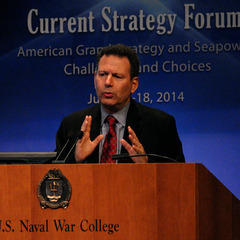
Robert D. Kaplan
Robert D. Kaplan

Robert D. Kaplan is an American journalist and writer born on June 23, 1952. He is renowned for his work in the fields of international politics, geopolitics, and military strategy, known for his in-depth analysis and unique insights. more

You May Also Like

“The Northwestern Carpathians, in which I was raised, were a hard place, as unforgiving as the people who lived there, but the Alpine landscape into which Zlee and I were sent that early winter seemed a glimpse of what the surface of the earth looked and felt and acted like when there were no maps or borders, no rifles or artillery, no men or wars to claim possession of land, and snow and rock alone parried in a match of millennial slowness so that time meant nothing, and death meant nothing, for what life there was gave in to the forces of nature surrounding and accepted its fate to play what role was handed down in the sidereal march of seasons capable of crushing in an instant what armies might--millennia later--be foolish enough to assemble on it heights. And yet there we were, ordered to march ourselves, for God, not nature, was with us now, and God would deliver us, in this world and next, when the time came for that.”

“Michael Ledeen—a contributing editor of National Review and a Freedom Scholar at the influential neoconservative think tank American Enterprise Institute—wrote on the National Review blog in November 2006: 'I had and have no involvement with our Iraq policy'. I opposed the military invasion of Iraq before it took place.' Ledeen, however, wrote in August 2002 of 'the desperately-needed and long overdue war against Saddam Hussein' and when he was interviewed for Front Page Magazine the same month and asked, 'Okay, well if we are all so certain about the dire need to invade Iraq, then when do we do so?' Ledeen replied: 'Yesterday.' There is obvious, substantial risk in falsely claiming that one opposed the Iraq War notwithstanding a public record of support. But that war has come to be viewed as such a profound failure that that risk, at least in the eyes of some, is outweighed by the prospect of being associated with Bush's invasion.”

“The fact that in the twentieth century a greater proportion of the people in the world could communicate with one another, using English or just a few other languages, appears not to have stopped any wars, nor to have reduced the frequency with which wars have broken out, nor to have made the wars that have broken out less brutal. In fact, several murderous wars have been fought recently among people who speak 'the same language' in real terms.”