Quotessence
Home / Quotes / Quote by Colson Whitehead

Quote by Colson Whitehead

“Turns out if you write about police violence and atrocities, if you wait a month, it'll happen again, so... That's America.”

Quote by Colson Whitehead

Author
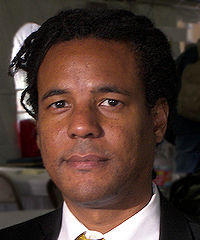
Colson Whitehead
Colson Whitehead

Colson Whitehead is an American novelist known for his distinctive literary style and profound insights into historical themes. His works cover a range of topics from slavery to modern urban life, with his 'New York Trilogy' and 'The Underground Railroad' being particularly notable. more

You May Also Like

“The system's acts are covert, just as the racist ideas of the people are implicit. I could not wrap my head around the system or precisely define it, but I knew the system was there, like the polluted air in our atmosphere, poisoning Black people to the benefit of White people. But what if the atmosphere of racism has been polluting most White people, too?”

“I thought I had it all figured out. I thought of racism as an inanimate, immortal system, not as a living, recognizable, mortal disease of cancer cells that we could identify and treat and kill. I considered the system as essential to the United States and the Constitution. At times, I thought White people covertly operated the system, fixed it to benefit the total White community at the expense of the total Black community. The construct of covert institutional racism opens American eyes to racism and, ironically, closes them, too. Separating the overt individual from the covert institutional veils the specific policy choices that cause racial inequities, policies made by specific people. Covering up the specific policies and policymakers prevents us from identifying and replacing the specific policies and policy makers. We become unconscious to racist policymakers and policies as we lash out angrily at the abstract bogeyman of "the system.”

“[...] white supremacy and coloniality still form the glue for the institutional and intellectual disciplinarity of western critical thought. Since the ideas of the Black Panther Party are limited to concerns with ethnic racism elsewhere, they do not register as thought qua thought, and can thus be exploited by and elevated to universality only in the hands of European thinkers such as Foucault, albeit without receiving any credit. [Dear reader, if this reminds you of the colonial expropriation of natural resources, you would be neither wrong nor alone in making such an assumption. In the words of Kanye West: that shit cray.]”

“A cop on a motorcycle roared alongside, waved them to the curb. 'Goin' to a fire?' he demanded. He peered into the car and Lutie saw a slight stiffening of his face. That meant he had seen they were colored. She waited for his next words with a wincing feeling, thinking it was like having an old wound that had never healed and you could see someone about to knock against it and it was too late to get out of the way, and there was that horrible tiny split second of time when you waited for the contact, anticipating the pain and quivering away from it before it actually started. The cop's mouth twisted into an ugly line.”

“The women work because the white folks give them jobs—washing dishes and clothes and floors and windows. The women work because for years now the white folks haven’t liked to give black men jobs that paid enough for them to support their families. And finally it gets to be too late for some of them. Even wars don’t change it. The men get out of the habit of working and the houses are old and gloomy and the walls press in. And the men go off, move on, slip away, find new women. Find younger women.”

“That writing as careless as Däniken's, whose principal thesis is that our ancestors were dummies, should be so popular is a sober commentary on the credulousness and despair of our times. I also hope for the continuing popularity of books like Chariots of the Gods? in high school and college logic courses, as object lessons in sloppy thinking. I know of no recent books so riddled with logical and factual errors as the works of Däniken.”

“I watched these young people read to the audience parts of history that placed our country in context. I felt, in that moment, envious of them. Had I known when I was younger what some of these students were sharing, I felt as if I would have been liberated from a social and emotional paralysis that for so long I could not name--a paralysis that had arisen from never knowing enough of my own history to effectively identify the lies I was being told by others: lies about what slavery was and what it did to people; lies about what came after our supposed emancipation; lies about why our country looks the way it does today. I had grown up in a world that never tired of telling me and other Black children like me all of the things that were wrong with us, all of the things we needed to do better. But not enough people spoke about the reason so many Black children grow up in communities saturated with poverty and violence. Not enough people spoke about how these realities were the result of decisions made by people in power and had existed for generations before us.”

“I asked [my grandfather] if there would ever be an America in which white Americans were not actively working to keep themselves positioned atop the racial hierarchy. He thought for a moment and then said, "Some of them will never give it up.”