Quotessence
Home / Quotes / Quote by Fredric Brown

Quote by Fredric Brown

“YOU're just what he'd have dreamed himself to be. You - he - used to write me long letters, full of corny humor, to my Rockettalk Department, and you called me Rocky, and you didn't like our covers because the monsters weren't horrible enough' He stopped. And again his mouth fell open.”

Quote by Fredric Brown

Author
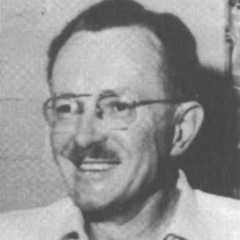
Fredric Brown
Fredric Brown

Fredric Brown was an American science fiction writer known for his unique style and profound philosophical insights. His works covered a range of themes from horror to science fiction, and had a significant influence on later writers. more

You May Also Like

“Where does all that leave the cinema? First, we must acknowledge that a film is a photograph of a drama, and that skilful use of the camera can never excuse the paltriness, sentimentality or weakness of the action. What I have said about modernism and its search for an art that will perpetuate the ethical vision, applies as much to the cinema as it does to the other arts. There are directors who have presented dramas that can be compared with the great modern works for the stage – Bergman, for instance, in Wild Strawberries, where an original situation, conveyed through masterly dialogue, is enhanced by dream sequences and flashbacks of a kind that can be managed successfully only through the skilful cutting that is the essential ingredient in cinematic art. Secondly, however, we must remember the distinction between fantasy and imagination, and the inherent tendency of the camera to realise what it shows – to present not a world of imagination, but a substitute reality. This is never more obvious than in the case of sex and violence, and is the root cause of the fact that these now dominate the cine screen, and would dominate television too, were it not for the censor. With the aid of the camera you can realise violence or the sexual act completely, and so minister to the fantasy which has sex or violence as its focus. If fantasy breaks through the tissue of imagination, then the dramatic thought is scattered, and the imaginative emotions along with it: drama then sinks into the background, and all that we have is obscenity – human flesh without the soul. Hence many people are quickly satiated by cinematic representations, and at the same time deeply disturbed and absorbed by features (violence in particular) which, from the dramatic point of view, have little intrinsic meaning. Imagination withers when realisation blooms, and the ethical view of our condition withers along with it. It is a significant fact that most cinema-goers are disposed to see their favourite films only a few times, and that even people whose interest is not in the drama but in the blood, screams, and orgasms have no great interest in revisiting the last occasion of excitement, and will proceed joylessly to the next one without raising the question of the value of what they watch. This contrasts with every other kind of dramatic art – theatre, novel, opera, dramatic poem – in which the perception of beauty brings with it a desire constantly to return to the source, to re-enact in our emotions a drama which never loses its point for us, since it touches the question why we are here.”

“Moreover, there are things that it is wrong to watch but permissible to do — and I think this point would not have needed spelling out in the days before Internet pornography, and all the other temptations that lie in wait for our contemporaries. ‘ What am I doing watching this? ’ is a deep moral reaction — the ‘ guilt ’ version of the shame that would accompany the knowledge Downloaded from that other people are watching you watching. To explore this aspect of fantasy, which has of course been of great concern to psychologists and psychotherapists in recent years, is beyond my scope. But it points us towards an important feature of fantasy, which again distinguishes it from imagination — namely, that fantasy is addictive, and exhibits the pattern of press-button rewards which we find in other addictions. Neuroscientists have had a lot to say about this pattern, and about the dopamine surges on which it depends. But it is not simply a matter of deviant neural pathways. There is a deviant intentionality involved in fantasy, and one that is connected with other deviations from what I call the ‘ aesthetic understanding ’ — a pathway back to the self, that escapes the demands of the other”

“The observer effect puts our everyday perceptions and assumptions in a blender. It dictates—if we’re to be honest with ourselves, sober in our thinking, and not reactionary in our emotions—that the world we see is NOT the ultimate reality, but merely a projection of it. From this perspective the manifest world is revealed as what Hindu mystics referred to as maya, illusion, the imaginal outpourings of minds—like children naturally playing in magical constructs that seem eminently real—simply doing what minds do.”

“A critical piece of holistic self-becoming involves the deeply felt realization that our thoughts, beliefs and intentions aren’t merely mental or ‘just imaginary’ events. On the contrary, they’re potent forces interacting synergistically with the quantum field, the biofield of the Universal Mind, if you will. In a culture crafted by eager yes-men and -women to an overbearing materialism, this may be a hard pill to swallow. But that doesn’t change this clear (to many anyway) dynamic: the simply powerful act of observation influences the universe at its most basic level.”