“The protection guaranteed by the Amendments is much broader in scope. The makers of our Constitution undertook to secure conditions favorable to the pursuit of happiness. They recognized the significance of man’s spiritual nature, of his feelings, and of his intellect. They knew that only a part of the pain, pleasure and satisfactions of life are to be found in material things. They sought to protect Americans in their beliefs, their thoughts, their emotions and their sensations. They conferred, as against the Government, the right to be let alone—the most comprehensive of rights and the right most valued by civilized men. To protect that right, every unjustifiable intrusion by the Government upon the privacy of the individual, whatever the means employed, must be deemed a violation of the Fourth Amendment. And the use, as evidence in a criminal proceeding, of facts ascertained by such intrusion must be deemed a violation of the Fifth. [Olmstead v. United States, 277 U.S. 438 (1928) (dissenting)]”
Quote by Louis D. Brandeis
Author
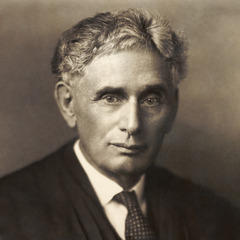
Louis D. Brandeis
Louis D. Brandeis was a former Associate Justice of the Supreme Court of the United States, known for his contributions to law and social justice. He was born on November 13, 1856, and died on October 5, 1941. more
You May Also Like
“We wouldn't have to take your rights away if you'd just stop exercising them.”
Source: The Goblins of Eros
“Bill of Rights: (n.) official tally of how much our rights cost to keep.”
Source: The Angel's Dictionary
Source: The Prophet Armed: Trotsky, 1879-1921
Source: On Liberty