Quotessence
Home / Quotes / Quote by Aldo Leopold

Quote by Aldo Leopold

“What is a hobby anyway? Where is the line of demarcation between hobbies and ordinary normal pursuits? I have been unable to answer this question to my own satisfaction. At first blush I am tempted to conclude that a satisfactory hobby must be in large degree useless, inefficient, laborious, or irrelevant. Certainly many of our most satisfying avocations today consist of making something by hand which machines can usually make more quickly and cheaply, and sometimes better. Nevertheless I must in fairness admit that in a different age the mere fashioning of a machine might have been an excellent hobby... Today the invention of a new machine, however noteworthy to industry, would, as a hobby, be trite stuff. Perhaps we have here the real inwardness of our own question: A hobby is a defiance of the contemporary. It is an assertion of those permanent values which the momentary eddies of social evolution have contravened or overlooked. If this is true, then we may also say that every hobbyist is inherently a radical, and that his tribe is inherently a minority. This, however, is serious: Becoming serious is a grievous fault in hobbyists. It is an axiom that no hobby should either seek or need rational justification. To wish to do it is reason enough. To find reasons why it is useful or beneficial converts it at once from an avocation into an industry–lowers it at once to the ignominious category of an 'exercise' undertaken for health, power, or profit. Lifting dumbbells is not a hobby. It is a confession of subservience, not an assertion of liberty.”

Quote by Aldo Leopold

Work

A Sand County Almanac and Sketches Here and There

Browse quotes and source details for this work. more

Author
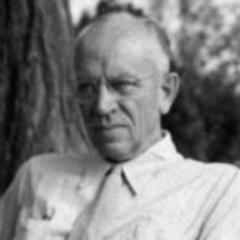
Aldo Leopold
Aldo Leopold

Aldo Leopold was an American author, philosopher, conservationist, and environmentalist. He is best known for his book 'A Sand County Almanac', which is considered a foundational text in environmental ethics and wildlife management. Leopold was born on January 11, 1887, and passed away on April 21, 1948. more

You May Also Like

“The publicists of mass-production economics have successfully altered public taste to believe it doesn’t make sense to repair something old when for the same price you can have something new.”

“If you accept mass production, you accept that a small number of people will supervise the daily existence of a much larger number of people. You accept that human beings will spend long hours, every day, engaged in repetitive work, while suppressing any desires for experience or activity beyond this work. The workers' behaviour becomes subject to the machine. With mass production, you also accept that huge numbers of identical items will need to be efficiently distributed to huge numbers of people and that institutions such as advertising will arise to do this. One technological process cannot exist without the other, creating symbiotic relationships among technologies themselves.”

“Dear Son, Protect your eyes from spiritual distraction, your ears from spiritual contamination, your heart from spiritual deterioration, and your mind from spiritual condemnation. On a daily basis, guard your soul with steadfast determination.”

“Of course the post-war development of cheap luxuries has been a very fortunate thing for our rulers. It is quite likely that fish-and-chips, art-silk stockings, tinned salmon, cut-price chocolate (five two-ounce bars for sixpence), the movies, the radio, strong tea, and the Football Pools have between them averted revolution. Therefore we are some-times told that the whole thing is an astute manoeuvre by the governing class–a sort of 'bread and circuses' business–to hold the unemployed down. What I have seen of our governing class does not convince me that they have that much intelligence. The thing has happened, buy by an un-conscious process–the quite natural interaction between the manufacturer's need for a market and the need of half-starved people for cheap palliatives.”

“In another building, I was shown his [Mr Brunel's] manufactory of shoes, which, like the other, is full of ingenuity, and, in regard to subdivision of labour, brings this fabric on a level with the oft-admired manufactory of pins. Every step in it is effected by the most elegant and precise machinery; while as each operation is performed by one hand, so each shoe passes through twenty-five hands, who complete from the hide, as supplied by the currier, a hundred pair of strong and well-finished shoes per day. All the details are performed by ingenious applications of the mechanic powers, and all the parts are characterized by precision, uniformity, and accuracy. As each man performs but one step in the process, which implies no knowledge of what is done by those who go before or follow him, so the persons employed are not shoemakers, but wounded soldiers, who are able to learn their respective duties in a few hours. The contract at which these shoes are delivered to government is 6s. 6d. per pair, being at least 2s. less than what was paid previously for an unequal and cobbled article. While, however, we admire these triumphs of mechanics, and congratulate society on the prospect of enjoying more luxuries at less cost of human labour, it ought not to be forgotten, that the general good in such cases is productive of great partial evils, against which a paternal government ought to provide. No race of workmen being proverbially more industrious than shoemakers, it is altogether unreasonable, that so large a portion of valuable members of society should be injured by improvements which have the ultimate effect of benefiting the whole.”

“I imagined that a better world would be less complicated, less involved, and with less need to mass produce doorknobs and lock sets, electric outlets, power cords, frozen chicken wings, packages of steak, rubber bands, and a million little foam earbuds that slip over the broadcasting end of an iPod. I'd stand staring at Jenna's room, the recycling porch, and imagine what my life would be like if I could squeeze all my worldly possessions into a space like that.”

“Soiree in Rome. The women are more attractive than the men - they always are. My first impression is that all the men are ugly (they are producers and film directors) and that all the women are beautiful (they are actresses). On a second view: the men are ugly, but they have character; all the women have something erotic about them, but nothing remarkable - a purely macho society, the world of showbiz. The big scene with the male lead is played out in all its grandeur, from one palazzo to the next in the Roman night. The most beautiful actress I know is marrying a rich director, author of 97 screenplays. This is the rule among the showbiz crowd. As usual I feel alienation from all the men there and solidarity with all the women, whom the men pretend to scorn in order to please them, but to whom they are basically indifferent. It must be nice to live in bodies so beautiful, so ingenuous, and allow the men to dominate you with all their ugliness, wealth and pretensions. It must be marvellous to be a woman. Ultimately, it is this which is fascinating: woman is unimaginable. The more beautiful she is, the more unimaginable.”