Quotessence
Home / Quotes / Quote by John Berger

Quote by John Berger

“Its All About Choice - The way we see things is affected by what we know or what we believe. In the Middle Ages when men believed in the physical existence of Hell the sight of fire must have meant something different from what it means today. Nevertheless their idea of Hell owed a lot to the sight of fire consuming and the ashes remaining - as well as to their experience of the pain of burns. When in love, the sight of the beloved has a completeness which no words and no embrace can match : a completeness which only the act of making love can temporarily accommodate. Yet this seeing which comes before words, and can never be quite covered by them, is not a question of mechanically reacting to stimuli. (It can only be thought of in this way if one isolates the small part of the process which concerns the eye's retina.) We only see what we look at. To look is an act of choice. As a result of this act, what we see is brought within our reach - though not necessarily within arm's reach. To touch something is to situate oneself in relation to it. (Close your eyes, move round the room and notice how the faculty of touch is like a static, limited form of sight.) We never look at just one thing; we are always looking at the relation between things and ourselves. Our vision is continually active, continually moving, continually holding things in a circle around itself, constituting what is present to us as we are.”

Quote by John Berger

Author
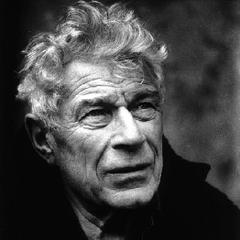
John Berger
John Berger

John Berger, born on November 5, 1926 and died on January 2, 2017, was a renowned British art critic and writer. His work spanned across various fields including painting, photography, and literature, known for his unique perspective and profound insights. more

You May Also Like

“This great artist is a man whose life-time is consumed by struggle : partly against material circumstances, partly against incomprehension, partly against himself... ... In no other culture has the artist been thought of in this way. Why then in this culture? We have already referred to the exigencies of the open art market. But the struggle was not only to live. Each time a painter realized that he was dissatisfied with the limited role of painting as a celebration of material property and of the status that accompanied it, he inevitably found himself struggling with the very language of his own art as understood by the tradition of his calling. ... ... Every exceptional work was the result of a prolonged successful struggle. Innumerable works involved no struggle. There were also prolonged yet unsuccessful struggles. (P.104)”

“Publicity images often use sculptures or paintings to lend allure or authority to their own message. Framed oil paintings often hang in shop windows as part of their display. Any work of art 'quoted' by publicity serves two purposes. Art is a sign of affluence; it belongs to the good life; it is part of the furnishing which the world gives to the rich and the beautiful. But a work of art also suggests a cultural authority, a form of dignity, even of wisdom, which is superior to any vulgar material interest; an oil painting belongs to the cultural heritage; it is a reminder of what it means to be a cultivated European. And so the quoted work of art (and this is why it is so useful to publicity) says two almost contradictory things at the same time: it denotes wealth and spirituality: it implies that the purchase being proposed is both a luxury and a cultural value. Publicity has in fact understood the tradition of the oil painting more thoroughly than most art historians. It has grasped the implications of the relationship between the work of art and its spectator-owner and with these it tries to persuade and flatter the spectator-buyer. The continuity, however, between oil painting and publicity goes far deeper than the 'quoting' of specific paintings. Publicity relies to a very large extent on the language of oil painting. It speaks in the same voice about the same things. (P. 129)”

“I am an eye. A mechanical eye. I, the machine, show you a world the way only I can see it. I free myself for today and forever from human immobility. I’m in constant movement. I approach and pull away from objects. I creep under them. I move alongside a running horse’s mouth. I fall and rise with the falling and rising bodies. This is I, the machine, manoeuvring in the chaotic movements, recording one moment after another in the most complex combinations. Freed from the boundaries of time and space. I co-ordinate any and all points of the universe, wherever I want them to be. My way leads towards the creation of a fresh perception of the world. Thus I explain in a new way the world unknown to you. - Dziga Vertov 1923”