Quotessence
Home / Quotes / Quote by Marguerite Yourcenar

Quote by Marguerite Yourcenar

“Je suis contre le particularisme de pays, religion, d'espece. Ne comptez pas sur moi pour faire du particularisme de sexe. Je crois qu'une bonne femme vaut un homme bon, qu'une femme intelligente vaut un homme intelligent. C'est une verite simple.”

Quote by Marguerite Yourcenar

Author
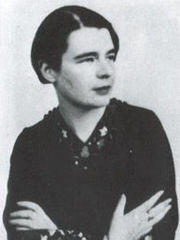
Marguerite Yourcenar

Marguerite Yourcenar was a renowned French novelist, known for her historical novels. Her works are celebrated for their profound insight and rich imagination, with her most famous novel being 'Orlando'. Born on June 8, 1903, she passed away on December 17, 1987. more

You May Also Like

“At its best fashion is a game. But for women it's a compulsory game, like net ball, and you can't get out of it by faking your period. I know I have tried. And so for a woman every outfit is a hopeful spell, cast to influence the outcome of the day. An act of trying to predict your fate, like looking at your horoscope. No wonder there are so many fashion magazines. No wonder the fashion industry is worth an estimated 900 billion dollars a year. No wonder every woman's first thought is, for nearly every event in her life, be it work, snow or birth. The semi-despairing cry of "but what will I wear?" Because when a woman says I have nothing to wear, what she really means is there is nothing here for who I am supposed to be today.”

“[At the British Museum] For it is a perennial puzzle why no woman wrote a word [in the time of Shakespeare] when every other man, it seemed, was capable of song or sonnet. What were the conditions in which women lived, I asked myself; (...) [In] Professor Trevelyan's History of England [one can read that] wife-beating [or daughter-beating] was a recognized right of man (...) [A woman] could hardly read, could scarcely spell, and was the property of her husband [or father]. Here I am asking why women did not write poetry in the Elisabethan age, and I am not sure how they were educated; whether they were taught to write; whether they had sitting-rooms to themselves; how many women had children before they were 21; what, in short, they did from eight in the morning till eight at night. They had no money evidently; (...) they were married whether they liked it or not (...) at fifteen or sixteen very likely... [Under these circumstances] It would have been extremely odd (...) for any woman to have written the plays of Shakespeare in the age of Shakespeare. (...) When, however, one reads of a witch being ducked, of a woman possessed by devils, of a wise woman selling herbs, or even of a very remarkable man who had a mother, then I think we are on the track of a lost novelist, a suppressed poet (...). Indeed, I would venture to guess that Anom, who wrote so many poems without signing them, was often a woman. (...) And undoubtedly, I thought, looking at the shelf where there are no plays by women, her work would have gone unsigned. That refuge she would have sought certainly.”