Quotessence
Home / Quotes / Quote by Leo Tolstoy

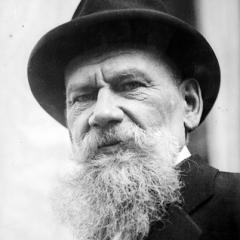
Quote by Leo Tolstoy

“To evoke in oneself a feeling one has once experienced, and having evoked it in oneself, then by means of movements, lines, colors, sounds, or forms expressed in words, so to transmit that feeling that others may experience the same feeling - this is the activity of art.”

Quote by Leo Tolstoy

Work

What Is Art?

This book delves into the essence of art, examining its role in human culture and the diverse ways it has been defined and appreciated across different eras and societies. more

Author

Leo Tolstoy
Leo Tolstoy

Leo Tolstoy was a Russian writer and thinker, a prominent representative of 19th-century Russian literature. His works deeply revealed social contradictions and human nature, and had a profound impact on the world. more

You May Also Like

“I have treated many artists. There are among them many neurotics, so many that one finally comes to believe that one cannot be an artist without being neurotic. Again I found in them that inner conflict which is characteristic of modern man: the conflict between a right intuition (namely, that their vocation has fundamental importance for the destiny of humanity) and a false idea (namely, that art is superfluous luxury).”

“The Ilhalmiut do not fill canvases with their paintings, or inscribe figures on rocks, or carve figurines in clay or in stone, because in the lives of the People there is no room for the creation of objects of no practical value. What purpose is there in creating beautiful things if these must be abandoned when the family treks out over the Barrens? But the artistic sense is present and strongly developed. It is strongly alive in their stories and songs, and in the string-figures, but they also use it on the construction of things which assist in their living and in these cases it is no less an art. The pleasure of abstract creation is largely denied to them by the nature of the land, but still they know how to make beauty. They know how to make beauty, and they also know how to enjoy it-- for it is no uncommon thing to see an Ilhalmio man squatting silently on a hill crest and watching, for hours at a time, the swift interplay of colors that sweep the sky at sunset and dawn. It is not unusual to see an Ilhalmio pause for long minutes to watch the sleek beauty of a weasel or to stare into the brilliant heart of some minuscule flower. And these things are done quite unconsciously, too. There is no word for 'beauty'--as such--in their language; it needs no words in their hearts.”

“No respect for beauty – that was characteristic of today’s society. The works of the great masters were at most employed as ironic references, or used in advertising. Michelangelo’s ‘The Creation of Adam’, where you see a pair of jeans in place of the spark. The whole point of the picture, at least as he saw it, was that these two monumental bodies each came to an end in two index fingers that almost, but not quite, touched. There was a space between them a millimetre or so wide. And in this space – life. The sculptural size and richness of detail of this picture was simply a frame, a backdrop, to emphasise the crucial void in its centre. The point of emptiness that contained everything. And in its place a person had superimposed a pair of jeans.”

“Just as when we step into a mosque and its high open dome leads our minds up, up, to greater things, so a great carpet seeks to do the same under the feet. Such a carpet directs us to the magnificence of the infinite, veiled, yet never near, closer than the pulse of jugular, the sunburst that explodes at the center of a carpet signals this boundless radiance. Flowers and trees evoke the pleasures of paradise, and there is always a spot at the center of the carpet that brings calm to the heart. A single white lotus flower floats in a turquoise pool, and in this tiniest of details, there it is: a call to the best within, summoning us to the joy of union. In carpets, I now saw not just intricacies of nature and color, not just mastery of space, but a sign of the infinite design. In each pattern lay the work of a weaver of the world, complete and whole; and in each knot of daily existence lay mine.”

“Although the art world reveres the unconventional, it is rife with conformity. Artists make work that "looks like art" and behave in ways that enhance stereotypes. Curators pander to the expectations of their peers and their museum boards. Collectors run in herds to buy work by a handful of fashionable painters. Critics stick their finger in the air to see which way the wind is blowing so as to "get it right". Originality is not always rewarded, but some people take real risks and innovate, which gives a raison d'être to the rest.”

“Beauty! Wasn't that what mattered? Beauty was hardly a popular ideal at that jumpy moment in history. The masses had been desensitized to it, the intelligentsia regarded it with suspicion. To most of her peers, 'beauty' smacked of the rarefied, the indulgent, the superfluous, the effete. How could persons of good conscience pursue the beautiful when there was so much suffering and injustice in the world? Ellen Cherry's answer was that if one didn't cultivate beauty, soon he or she wouldn't be able to recognize ugliness. The prevalence of social ugliness made commitment to physical beauty all the more essential. And the very presence in life of double-wide mobile homes, Magic Marker graffiti, and orange shag carpeting had the effect of making ills such as poverty, crime, repression, pollution, and child abuse seem tolerable. In a sense, beauty was the ultimate protest, and, in that it generally lasted longer than an orgasm, the ultimate refuge. The Venus de Milo screamed 'No!' at evil, whereas the Spandex stretch pant, the macrame plant holder were compliant with it. Ugly bedrooms bred ugly habits. Of course, it wasn't required of beauty that it perform a social function. That was what was valuable about it.”