“In respect to the employment of troops, ground may be classified as dispersive, frontier, key, communicating, focal, serious, difficult, encircled, and death. When a feudal lord fights in his own territory, he is in dispersive ground. Here officers and men long to return to their nearby homes. When he makes but a shallow penetration into enemy territory he is in frontier ground. Ground equally advantageous for the enemy or me to occupy is key ground. Ground equally accessible to both the enemy and me is communicating. This is level and extensive ground in which one may come and go, sufficient in extent for battle and to erect opposing fortifications. When a state is enclosed by three other states its territory is focal. He who first gets control of it will gain the support of All-under-Heaven. When the army has penetrated deep into hostile territory, leaving far behind many enemy cities and towns, it is in serious ground. When the army traverses mountains, forests, precipitous country, or marches through defiles, marshlands, or swamps, or any place where the going is hard, it is in difficult ground. Ground to which access is constricted, where the way out is tortuous, and where a small enemy force can strike my larger one is called 'encircled.' Ground in which the army survives only if it fights with the courage of desperation is called 'death.' Therefore, do not fight in dispersive ground; do not stop in the frontier borderlands. Do not attack an enemy who occupies key ground; in communicating ground do not allow your formations to become separated. In focal ground, ally with neighboring states; in deep ground, plunder. In difficult ground, press on; in encircled ground, devise stratagems; in death ground, fight. In dispersive ground I would unify the determination of the army. In frontier ground I would keep my forces closely linked. In key ground I would hasten up my rear elements. In communicating ground I would pay strict attention to my defenses. In focal ground I would strengthen my alliances. I reward my prospective allies with valuables and silks and bind them with solemn covenants. I abide firmly by the treaties and then my allies will certainly aid me. In serious ground I would ensure a continuous flow of provisions. In difficult ground I would press on over the roads. In encircled ground I would block the points of access and egress. It is military doctrine that an encircling force must leave a gap to show the surrounded troops there is a way out, so that they will not be determined to fight to the death. Then, taking advantage of this, strike. Now, if I am in encircled ground, and the enemy opens a road in order to tempt my troops to take it, I close this means of escape so that my officers and men will have a mind to fight to the death. In death ground I could make it evident that there is no chance of survival. For it is the nature of soldiers to resist when surrounded; to fight to the death when there is no alternative, and when desperate to follow commands implicitly.”
Quote by Sun Tzu
Work
This seminal work explores the principles of warfare, leadership, and conflict resolution, offering timeless insights into the nature of power and the art of winning battles without resorting to brute force. more
Author
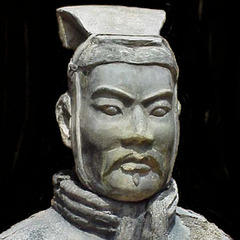
Sun Tzu, born around 544 BC and died around 496 BC, was a renowned Chinese military strategist. His military thoughts are mainly reflected in his book 'The Art of War', which is considered the classic of military strategy and has had a profound impact on various fields such as military, politics, and economics in later generations. more
You May Also Like
“The obesity epidemic coincided with the deployment of cell phone towers.”
“If releasing is hard, people will always find a reason not to release.”
“I regard the global deployment of 5G transmitters as a form of terrorism.”