Quotessence
Home / Quotes / Quote by John Steinbeck

Quote by John Steinbeck

“It was strange to Old Robert that he, who knew so much more than his neighbors, who had pondered so endlessly, should be not even a good farmer. Sometimes he imagined he understood too many things ever to do anything well.”

Quote by John Steinbeck

Work

Cup of Gold

Browse quotes and source details for this work. more
Author

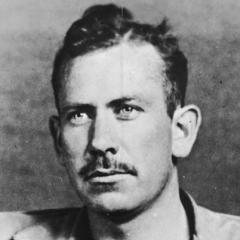
John Steinbeck
John Steinbeck

John Steinbeck was an American author renowned for his profound depiction of American society and the lives of farmers. His works often explore themes of poverty, social injustice, and human nature. Steinbeck was awarded the Nobel Prize in Literature in 1962 for his significant contribution to American literature. more

You May Also Like

“Lyndon Johnson was a master of self-justification. According to his biographer Robert Caro, when Johnson came to believe in something, he would believe in it “totally, with absolute conviction, regardless of previous beliefs, or of the facts in the matter.” George Reedy, one of Johnson’s aides, said that he “had a remarkable capacity to convince himself that he held the principles he should hold at any given time, and there was something charming about the air of injured innocence with which he would treat anyone who brought forth evidence that he had held other views in the past. It was not an act… He had a fantastic capacity to persuade himself that the ‘truth’ which was convenient for the present was the truth and anything that conflicted with it was the prevarication of enemies. He literally willed what was in his mind to become reality.” Although Johnson’s supporters found this to be a rather charming aspect of the man’s character, it might well have been one of the major reasons that Johnson could not extricate the country from the quagmire of Vietnam. A president who justifies his actions only to the public might be induced to change them. A president who has justified his actions to himself, believing that he has the truth, becomes impervious to self-correction.”

“National Socialism made use of various means in dealing with various classes, and made various promises depending upon the social class it needed at a particular time. In the spring of 1933, for example, it was the revolutionary character of the Nazi movement that was given particular emphasis in Nazi propaganda in an effort to win over the industrial workers, and the first of May was "celebrated," but only after the aristocracy had been appeased in Potsdam. To ascribe the success solely to political swindle, however, would be to become entangled in a contradiction with the basic idea of freedom, and would practically exclude the possibility of a social revolution. What must be answered is: Why do the masses allow themselves to be politically swindled? The masses had every possibility of evaluating the propaganda of the various parties. Why didn't they see that, while promising the workers that the owners of the means of production would be disappropriated, Hitler promised the capitalists that their rights would be protected?”

“Poor feeling hijacks thinking for self-deception: to hide harsh truths, avoid action, evade responsibility, and, as the existentialists might put it, flee from freedom. Thus, poor feeling is a kind of moral failing, indeed, the deepest kind, and virtue principally consists in correcting and refining our emotions and the values that they reflect. To feel the right thing is to do the right thing, without any particular need for conscious thought or effort.”