Quotessence
Home / Quotes / Quote by Franz Kafka

Quote by Franz Kafka

“No hay defensa posible contra esta judicatura, ha que confesar. Haga la confesión en la próxima oportunidad que se le presente. Solo así tendrá la posibilidad de escapar”
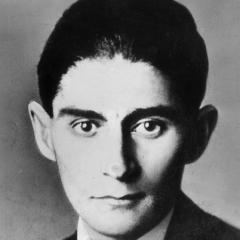
Quote by Franz Kafka

Work

The Trial

In this classic work, the protagonist, Joseph K., is arrested and subjected to a relentless and illogical trial. The narrative delves into the complexities of the legal system and the human condition, leaving readers pondering the nature of justice and the absurdity of life. more

Author

Franz Kafka
Franz Kafka

Franz Kafka (July 3, 1883 - June 3, 1924) was an important German-language novelist of the 20th century, known for his unique literary style and profound philosophical thoughts. His works, often themed around loneliness, alienation, and existentialism, have had a profound impact on literature and philosophy. more

You May Also Like

“When the president theanthropize himself in matters leadership and governance and takes the constitution and its guardians secondary to his decisions, the chief Justice should assume the role of the deicide of the alloyed beast. If he shows signs of the faint-hearted, the judiciary firewalls become weak to not withstand the threats posed by the executive thus turning into the executive's de facto corporation. This is how autocracy is midwived!”

“It was actually Thomas Jefferson himself who said 'we might as well ask a man to wear the coat that fitted him when he was a boy' as expect future generations to live under what he called 'the regime of their barbarous ancestors.' So even the founders that these kind of dead-hand originalists claim fidelity to understood better than their ideological descendants — today's judicial so-called conservatives — the importance of keeping with the times. And we deserve judges and justices who understand that.”

“The failure of Popper's demarcation criterion throws up an important question. Is it actually possible to find some common feature shared by all the things we call 'science...'? It may be that they share some fixed set of features that define what it is to be science, but it may not.... If so, a simple criterion for demarcating science from pseudo-science is unlikely to be found.”

“It is often asserted that, in view of the situation in quantum theory, object and subject can no longer be sharply separated. 1 To use Heitler’s words, the ‘separation of the world into an “objective outside reality”, and “us”, the self-conscious onlookers, can no longer be maintained. Object and subject become inseparable from each other’. 2 This, according to Bohr, is due to ‘the impossibility of any sharp separation between the behaviour of atomic objects and the interaction with the measuring instruments which serve to define the conditions under which the phenomena appear’. 3 Heitler elaborates the point in some detail. ‘One may ask’, he writes, ‘if it is sufficient to carry out a measurement by a self-registering apparatus or whether the presence of an observer is required.’ And he arrives at the conclusion that the self-registering apparatus is insufficient, and that ‘the observer appears, as a necessary part of the whole structure, and in his full capacity as a conscious being’.”