Quotessence
Home / Quotes / Quote by Ernest Hemingway

Quote by Ernest Hemingway

“There is not much future in men being friends with a great woman although it can be pleasant enough before it gets better or worse, and there is usually even less future with truly ambitious women writers.”

Quote by Ernest Hemingway

Work

A Moveable Feast

A personal narrative that delves into the author's life and work during his time in Paris, providing a vivid portrait of the city and its literary scene. more
Author

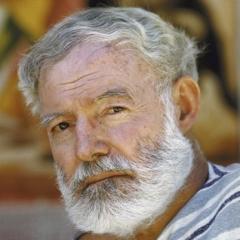
Ernest Hemingway
Ernest Hemingway

American author known for his concise and forceful writing style, as well as his profound insights into life. Hemingway's works cover a wide range of themes including war, adventure, and love, with notable titles such as 'The Old Man and the Sea' and 'A Farewell to Arms'. more

You May Also Like

“As the discoverer and principal excavator of Murray Springs, [...] Haynes deserves credit for drawing attention to a very curious aspect of the site--a distinct dark layer of soil draped 'like a shrink-wrap,' as Allen West puts it, over the top of the Clovis remains and of the extinct megafauna--including Eloise. Haynes has identified this 'black mat' (his term) not only at Murray Springs but at dozens of other sites across North America, and was the first to acknowledge its clear and obvious association with the Late Pleistocene Extinction Event. he speaks of the 'remarkable circumstances' surrounding the event, the abrupt die-off on a continental scale of all large mammals 'immediately before deposition of the ... black mat,' and the total absence thereafter of 'mammoth, mastodon, horse, camel, dire wold, American lion, tapir and other [megafauna], as well as Clovis people.' Haynes notes also that 'The basal black mat contact marks a major climate change from the warm dry climate of the terminal Allerod to the glacially cold Younger Dryas.' From roughly 18,000 years ago, and for several thousand years thereafter, global temperatures had been slowly but steadily rising and the ice sheets melting. Our ancestors would have had reason to hope that earth's long winter was at last coming to an end and that a new era of congenial climate beckoned. This process of warming became particularly pronounced after about 14,500 years ago. Then suddenly, around 12,800 years ago, the direction of climate change reversed and the world turned dramatically, instantly cold--as cold as it had been at the peak of the Ice Age many thousands of years earlier. This deep freeze--the mysterious epoch now known as the Younger Dryas--lasted for approximately 1,200 years until 11,600 years ago, at which point the climate flipped again, global temperatures shot up rapidly, the remnant ice sheets melted and collapsed into the oceans, and the world became as warm as it is today.”

“If a failure to preserve and consider potentially controversial evidence has frustrated a full understanding of the Hypogeum, then the same is also true for the megalithic temples and even the prehistoric cave sites in Malta. Thus, Mifsud points out that archaeologists excavating Ghar Dalam cave in the early twentieth century [...] 'discovered several knives, scrapers, borers and burins in previously undisturbed deposits, and although stratigraphically Pleistocene, they have been arbitrarily attributed to the Neolithic'.”

“The Pleistocene period ended in death. This was no ordinary extinction of a vague geological period which fizzled to an uncertain end. This death was catastrophic and all-inclusive... The large animals that had given the name to the period became extinct. Their death marked the end of the era. But how did they die? What caused the extinction of forty million animals?”

“Art should return to its roots, to cosmology, to rite, and to ceremony. The religious nature of art is its true meaning. Modern art's commitment to "emotion" and "feeling" or to abstract principles of design is, by Pleistocene standards, a sacrilegious act, just as narcotics belong not in a recreational but in a religious setting. In most small-scale societies there is regular dialogue on divinatory and dream experience that gets translated into art.”