Quotessence
Home / Quotes / Quote by Dante Alighieri

Quote by Dante Alighieri

“And without fame, a man must spend his life Only to leave such traces upon earth As smoke leaves in the air, or foam in the sea”

Quote by Dante Alighieri

Author
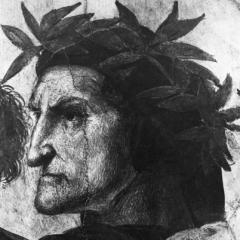
Dante Alighieri
Dante Alighieri

Dante Alighieri, an Italian poet and a pioneer of the Renaissance, is hailed as the father of Italian literature. Born in 1265 and died on September 14, 1321, Dante is best known for his epic poem, 'The Divine Comedy,' which is not only a great literary work but also a profound religious and philosophical treatise. more

You May Also Like

“Does John Green have a Hollywood Star? A John Green does but he is not me. He was a composer who won five Academy Awards for scoring such movies as An American in Paris and West Side Story. Although today he is mostly forgotten which is a nice reminder that no matter what you do the tides of time will wash away your sandcastles. So there's no sense in reaching for some foolhardy notion of immortality when there is real work to be done with real people, right now.”

“Fame', he (Orlando) said, 'is like .. a braided coat which hampers the limbs; a jacket of silver which curbs the heart; a painted shield which covers a scarecrow,' etc. etc. .. While fame impedes and constricts, obscurity wraps about a man like a mist; obscurity is dark, ample and free; obscurity lets the mind take its way unimpeded. Over the obscure man is poured the merciful suffusion of darkness. None knows where he goes or comes. He may seek the truth and speak it; he alone is free; he alone is truthful; he alone is at peace. .. Sunk for a long time in profound thoughts as to the value of obscurity, and the delight of having no name, but being like a wave which returns to the deep body of the sea; thinking how obscurity rids the mind of the irk of envy and spite; how it sets running in the veins the free waters of generosity and magnanimity; and allows giving and taking without thanks offered or praise given; which must have been the way of all great poets, he supposed, .. for, he thought, Shakespeare must have written like that, and the church builders built like that, anonymously, needing no thanking or naming, but only their work in the daytime and a little ale perhaps at night - 'What an admirable life this is,' he thought, stretching his limbs out under the oak tree. 'And why not enjoy it this very moment?”

“I have brought peace to this land, and security," he began. "And what of your soul, when you use the cleverness of argument to cloak such acts? Do you think that the peace of a thousand cancels out the unjust death of one single person? It may be desirable, it may win you praise from those who have happily survived you and prospered from your deeds, but you have committed ignoble acts, and have been too proud to own them. I have waited patiently here, hoping that you would come to me, for if you understood, then some of your acts would be mitigated. But instead you send me this manuscript, proud, magisterial, and demonstrating only that you have understood nothing at all." "I returned to public life on your advice, madam," he said stiffly. "Yes; I advised it. I said if learning must die it should do so with a friend by its bedside. Not an assassin.”

“Santi was a behemoth in the art world, and being known solely by one's first name was a level of fame achieved only by an elite few... people like Napoleon, Galileo, and Jesus... and, of course, the demigods Langdon now heard blaring from Harvard dormitories - Sting, Madonna, Jewel, and the artist formerly known as Prince, who had changed his name to the symbol ?, causing Langdon to dub him 'The Tau Cross With Intersecting Hermaphroditic Ankh.”

“How am I to become a legend, my dear? I’ve tried love, but that hides you in the bosom of another and I am always springing forth from it like the lotus—the ecstasy of always bursting forth! (but one must not be distracted by it!) or like a hyacinth, “to keep the filth of life away,” yes, there, even in the heart, where the filth is pumped in and courses and slanders and pollutes and determines. I will my will, though I may become famous for a mysterious vacancy in that department, that greenhouse.”

“I came back [to school] in the fall, as a full-time boarder, with a certain set to my jaw, determined to go it alone. A summer passed in thoughtful isolation, rowing on a mountain lake, diving from a pier, had made me perfectly reckless. I was going to get myself recognized at whatever price. It was in this cold, empty gambler’s mood, common to politicians and adolescents, that I surveyed the convent setup. If I could not win fame by goodness, I was ready to do it by badness.”