“What modern art has to do in the service of culture is so to rearrange the details of modern life, so to reflect it, that it may satisfy the spirit. And what does the spirit need in the face of modern life? The sense of freedom. That naive, rough sense of freedom, which supposes man's will to be limited, if at all, only by a will stronger than his, he can never have again. The attempt to represent it in art would have so little verisimilitude that it would be flat and uninteresting. The chief factor in the thoughts of the modern mind concerning itself is the intricacy, the universality of natural law, even in the moral order. For us, necessity is not, as of old, a sort of mythological personage without us, with whom we can do warfare: it is a magic web woven through and through us, like that magnetic system of which modern science speaks, penetrating us with a network, subtler than our subtlest nerves, yet bearing in it the central forces of the world. Can art represent men and women in these bewildering toils so as to give the spirit at least an equivalent for the sense of freedom? Certainly, in Goethe's romances, and even more in the romances of Victor Hugo, there are high examples of modern art dealing thus with modern life, regarding that life as the modern mind must regard it, yet reflecting upon blitheness and repose. Natural laws we shall never modify, embarrass us as they may; but there is still something in the nobler or less noble attitude with which we watch their fatal combinations. In those romances of Goethe and Victor Hugo, in some excellent work done after them, this entanglement, this network of law, becomes the tragic situation, in which certain groups of noble men and women work out for themselves a supreme Denouement. Who, if he saw through all, would fret against the chain of circumstance which endows one at the end with those great experiences?”
Quote by Walter Pater
Work
This book delves into the cultural and artistic developments of the Renaissance, analyzing the works of artists and poets from the period. It examines the influence of the Renaissance on the subsequent evolution of art and literature. more
Author
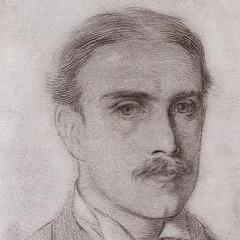
Walter Pater was a British essayist, critic, and poet, known for his influential literary criticism and contributions to the Aesthetic Movement. Born on August 4, 1839, and died on July 30, 1894, Pater's work had a significant impact on the development of modern literary theory and the appreciation of art and literature. more
You May Also Like
“Great coffee is an art, and every barista is an artist in the making.”
“What is truly beautiful has nothing to fear from disfigurement.”
“What is Art? Something one is good at and another one enjoys.”
“Technical achievement does not necessarily equate with artistic accomplishment.”