“Our democratic societies rest on a meritocratic worldview, or at any rate a meritocratic hope, by which I mean a belief in a society in which inequality is based more on merit and effort than on kinship and rents. This belief and this hope play a very crucial role in modern society, for a simple reason: in a democracy, the professed equality of rights of all citizens contrasts sharply with the very real inequality of living conditions, and in order to overcome this contradiction it is vital to make sure that social inequalities derive from rational and universal principles rather than arbitrary contingencies. Inequalities must therefore be just and useful to all, at least in the realm of discourse and as far as possible in reality as well.”
Quote by Thomas Piketty
Work
Capital in the Twenty First Century
Browse quotes and source details for this work. more
Author
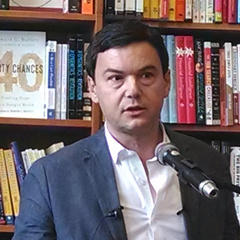
Thomas Piketty
Thomas Piketty is a renowned French economist born on May 7, 1971. His research focuses on income and wealth inequality, economic growth, and capital accumulation. Piketty is known for his in-depth studies on inequality and his influential book 'Capital in the Twenty-First Century' has had a global impact. more
You May Also Like
Source: Plutocrats: The Rise of the New Global Super Rich and the Fall of Everyone Else
Source: 1984
Source: The Idea of Prostitution
Source: London Calling
Source: The Conservative Revolution
Source: Behind the Beautiful Forevers: Life, death, and hope in a Mumbai undercity
Source: S.O.S. Alternatives to Capitalism
Source: The Irresistible Revolution: Living as an Ordinary Radical