Quotessence
Home / Quotes / Quote by Thomas Hardy

Quote by Thomas Hardy

“And then he again uneasily saw, as he had latterly seen with more and more frequency, the scorn of Nature for man’s finer emotions, and her lack of interest in his aspirations.”

Quote by Thomas Hardy

Work

Jude the Obscure

Thomas Hardy's novel follows the life of Jude Fawley, a man of humble origins who aspires to a higher education and a better life, only to face numerous challenges and heartbreaks in his pursuit of love and social mobility. more
Author

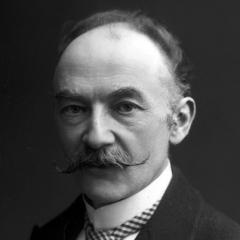
Thomas Hardy
Thomas Hardy

Thomas Hardy, a British novelist born on June 2, 1840, and died on January 11, 1928, is renowned for his novels that depict rural life, reflecting the social changes in 19th-century England. His works often carry a sense of pessimism, depicting the fates of characters with sympathy. more

You May Also Like

“Maybe she hated being out of control, knowing that someone or something else was dictating her fate. Because it's really not fair. A drunk driver runs a red light, and you end up dead. A guy in a movie theater coughs on you, and you catch some rare, fatal disease. You sit in class minding your own business, and there's the kid from sixth period holding a gun in his hand. Why should other people be in control? Why should someone else get to choose when you die?”

“Everyone," Ross said, "seems a little less concerned than I do. Am I more tender-hearted for others or only tender because of my own conscience?" "We are not–untender," she said. "Not so. But maybe we are more–resigned. When a man is condemned to death we accept it, though it's sad to do so. We know we cannot change it. You hoped to change it–so it's more of a–a disappointment. You feel you have failed. We don't feel that because we never hoped to succeed.”

“Since then many years have passed, and in those years I have often thought how strange are the ways of Fate. Set on one's waylay a single ill-considered spontaneous remark, one is led into a course of action that cannot be stopped whether one wants to or not. At the moment of departure we do not even dream of where our voyage will take us. Even when we have started we deluded ourselves for an unconscionable time that in a short while it will soon be over, and we shall be free again to do as we please. Sometimes, in forests, one meets two such paths that, although divided perhaps by a stream or ditch, seem at first sight to run parallel to one another. One imagines that whichever one chooses will lead us to the same place. However, slowly the paths diverge...and never meet again.”