Quotessence
Home / Quotes / Quote by Bayard Rustin

Quote by Bayard Rustin

“As the civil rights movement progressed, winning victory after victory in public accommodations and voting rights, it became increasingly conscious that these victories would not be secure or far-reaching without a radical improvement in the Negro's socioeconomic position. And so the movement reached out of the South into the urban centers of the North and the West. It moved from public accommodations to employment, welfare, housing, education--to find a host of problems the nation had let fester for a generation. But these were not problems that affected the Negro alone or that could be solved easily with the movement's traditional protest tactics. These injustices were imbedded not in ancient and obsolete institutional arrangements but in the priorities of powerful vested interests, in the direction of public policy, in the allocation of our national resources. Sit-ins could integrate a lunch counter, but massive social investments and imaginative public policies were required to eliminate the deeper inequalities.”

Quote by Bayard Rustin

Work

Down the Line: The Collected Writings of Bayard Rustin

Browse quotes and source details for this work. more

Author
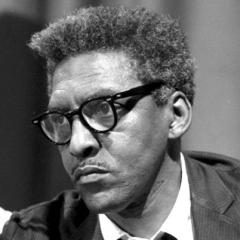
Bayard Rustin
Bayard Rustin

Bayard Rustin was a prominent African American civil rights activist who played a significant role in the American civil rights movement. He was a strategist and advisor to many civil rights leaders, including Martin Luther King Jr. Rustin was a key figure in the organization of the 1963 March on Washington for Jobs and Freedom, one of the largest political protests in U.S. history. He was also a leader in the gay rights movement and advocated for nonviolent protest and civil disobedience. more

You May Also Like

“So much about being a woman who's had the good fortune to be offered some choices, and yet not good enough fortune to live in a world with gender equality, is about giving up some of what we want and making peace with not "having it all". Many women give up dreams and ideals as they patch together careers, marriage, children. My career-centrered path should not be read as a rejection of the domestic and care aspects of life.”

“To understand why kids from low-income households do poorly in school, we would do well to understand what their lives at home are like. But we must also step back and situate their lives within the broader social context. This includes trying to understand whta material conditions are like for parents, what school experiences are like for kids, and finally and least often done, what higher-income families are doing for their kids. It is when we do all this that we can have a more complete and accurate understanding of how kids from low-income families, within this system, are compelled to play a game they cannot win because someone else is setting the rules.”

“In state discourse about poverty, notions about 'charity', and about those with more 'helping' those with less, have become increasingly salient. In tandem with this, a slew of new specialized agencies, programs and schemes, and personnel have been constructed to deal with'the needy'. This way of framing the problem of poverty isolates it - detaches the issues and challenges faced by a small minority of the population from those faced by everyone else. It dislodges the issue of poverty from the broader political economy in which it is produced. Importantly, it frames public intervention as 'charity', as 'help' - in other words, beyond public responsibility - and recipients as 'recipients' rather than as members of society with rights to certain basic levels of well-being and security.”

“They worry that I am assigning too much blame to the system and not granting "agency" to the low-income. They want me to say more about this group and they want me to suggest the right "nudges" that would push people to behave in certain ways. They want to know: what can we do to help "empower" the low-income so that they can help themselves? The problem with this mindset - not of those who are powerless but those who are relatively powerful - is that power is not a frame of mind but a material condition. People sitting in positions of authority are powerful not because they feel empowered bu because they have power. Their feelings of empowerment are an outcome of their actual ownership of power, not the cause. One can think - and indeed many of the low-income people I speak with do this - "I can do this. I must try". But if one is in fact lacking in power - lacking in control over time; lacking in leverage in the labour market; lacking in bargaining power with managers, teachers, social workers, landlords, creditors - no amount of merely changing how they think about themselves will change these realities.”

“Un ami à qui je racontais ma mésaventure m’a dit en riant : « Ça t’apprendra à admirer des fascistes. » C’était expéditif et, je crois, juste. Herzog, capable d’une vibrante compassion pour un aborigène sourd-muet ou un vagabond schizophrène, considérait un jeune cinéphile à lunettes comme une punaise méritant d’être moralement écrabouillée, et j’étais quant à moi le client idéal pour me faire traiter de la sorte. Il me semble qu’on touche là quelque chose qui est le nerf du fascisme. Si on le dénude, ce nerf, que trouve-t-on ? En étant radical, une vision du monde évidemment scandaleuse : übermenschen et untermenschen, Aryens et Juifs, d’accord, mais ce n’est pas de cela que je veux parler. Je ne veux parler ni de néonazis, ni d’extermination des présumés inférieurs, ni même de mépris affiché avec la robuste franchise de Werner Herzog, mais de la façon dont chacun de nous s’accommode du fait évident que la vie est injuste et les hommes inégaux : plus ou moins beaux, plus ou moins doués, plus ou moins armés pour la lutte. Nietzsche, Limonov et cette instance en nous que j’appelle le fasciste disent d’une même voix : « C’est la réalité, c’est le monde tel qu’il est. » Que dire d’autre ? Ce serait quoi, le contre-pied de cette évidence ? « On sait très bien ce que c’est, répond le fasciste. Ça s’appelle le pieux mensonge, l’angélisme de gauche, le politiquement correct, et c’est plus répandu que la lucidité. » Moi, je dirais : le christianisme. L’idée que, dans le Royaume, qui n’est certainement pas l’au-delà mais la réalité de la réalité, le plus petit est le plus grand. Ou bien l’idée, formulée dans un sutra bouddhiste que m’a fait connaître mon ami Hervé Clerc, selon laquelle « l’homme qui se juge supérieur, inférieur ou même égal à un autre homme ne comprend pas la réalité »”

“They wanted to be safe. It’s not that much to ask, it feels like. But we don’t have it to begin with, and to get it and keep it, they’d push another kid into the dark. One enclave would push another into the dark for that, too. And they didn’t stop at safety, either. They wanted comfort, and then they wanted luxury, and then they wanted excess, and every step of the way they still wanted to be safe, even as they made themselves more and more of a tempting target, and the only way they could stay safe was to have enough power to keep everyone off that wanted what they had.”

“Being in servitude to the Anglo-Saxon race, I was not put into a "Jim Crow car," on our way to Rockaway, neither was I invited to ride through the streets on the top of trunks in a truck; but every where I found the same manifestations of that cruel prejudice, which so discourages the feelings, and represses the energies of the colored people.”