Quotessence
Home / Quotes / Quote by Emily Dickinson

Quote by Emily Dickinson

“The Soul selects her own Society— Then—shuts the Door— To her divine Majority— Present no more— Unmoved—she notes the Chariots—pausing— At her low Gate— Unmoved—an Emperor be kneeling Upon her Mat— I've known her—from an ample nation— Choose One— Then—close the Valves of her attention— Like Stone—”

Quote by Emily Dickinson

Work

Selected poems

This book compiles a selection of poems that showcase the depth and diversity of the author's poetic voice, exploring a range of subjects and employing different literary techniques. more

Author

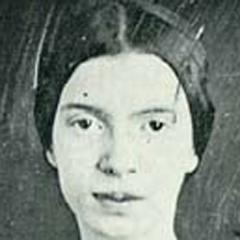
Emily Dickinson
Emily Dickinson

Emily Dickinson was a renowned American poet of the 19th century, known for her unique poetic style and profound introspection. Her poetry is characterized by its concise form and philosophical language, often exploring themes such as life, death, nature, and religion. more

You May Also Like

“Loyalty, while it can be admirable is also conditional. Dependent on forces inside and out, on perceptions, on likes and dislikes. It can be misguided and flawed, even dumb depending on circumstance. Integrity, however, has no conditions. It cannot be earned. It is not based on circumstance, but on inherent strength, belief and purpose. To be called loyal isn't necessarily a compliment. Hitler's henchman were loyal. To be recognized for integrity is a true honor.”

“The devil lives in the shadow of subtle things--those things people keep hidden from others. They reside in the lies they tell themselves, in order to justify their pain or fear. It is the slight, the dig, the silence and the unspoken truth that we minimize to a passive aggressive status, as if it were a lesser evil. Integrity is not subtle. It speaks loudly, so everyone can hear and be healed. It is something you will never have to search for because it is seen and felt.”

“JFK apparently felt genuine sympathy for his 1960 presidential opponent Richard Nixon. He felt that, with Nixon's frequent shifts in political philosophy and reinventions, he must have to decide which Nixon he will be at each stop. This, Kennedy reasoned, must be exhausting.”