Quotessence
Home / Quotes / Quote by Friedrich Nietzsche

Quote by Friedrich Nietzsche

Author

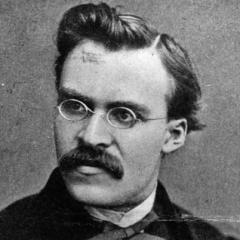
Friedrich Nietzsche
Friedrich Nietzsche

Friedrich Nietzsche was a German philosopher, cultural critic, poet, and writer whose works have had a profound impact on subsequent philosophy, literature, and thought. His ideas revolve around concepts such as the 'will to power', the 'Übermensch', and the 'eternal recurrence'. more

You May Also Like

“Ludwig Wittgenstein once greeted me with the question: »Why do people say that it was natural to think that the sun went round the earth rather than that the earth turned on its axis?” I replied: »I suppose, because it looked as if the sun went round the earth.” »Well,« he asked, »what would it have looked like if it had looked as if the earth turned on its axis?«”

“...I don't believe in Him, and if He does exist, I don't like Him. His type of gods aren't gods who echo how mortals behave. They're gods who are held up as example of perfection to be emulated. They're not gods of the people. They're remote and inaccessible, they demand blind, unthinking obedience from their followers. They're dictators. We Aesir and Vanir, by contrast, are mirrors. Other gods rule. We reflect and magnify. We are you, only more so. We share your flaws and foibles. We are as humanlike as we are divine, and I think we are all the better for that.”

“Forgiveness is giving up on the treacle of what has failed and moving towards that which is more ideal. It takes us from a negative logic of detesting something, to a space of emptiness, from which we can reconnect with creative logic and instead of acting out our fears of the negative, reach toward what may be beautiful.”

“We have a tendency to describe capitalism with familiar, well-worn words like ‘markets’ and ‘trade’. But this isn’t quite accurate. Markets and traders were around for thousands of years before capitalism, and they are innocent enough on their own. What makes capitalism different from most other economic systems in history is that it’s organised around the imperative of constant expansion, or ‘growth’: ever-increasing levels of industrial extraction, production and consumption, which we measure as Gross Domestic Product (GDP). Growth is the prime directive of capital. Not growth for any particular purpose, mind you, but growth for its own sake. And it has a kind of totalitarian logic to it: every industry, every sector, every national economy must grow, all the time, with no identifiable end-point.”