Quotessence
Home / Quotes / Quote by Joseph Conrad

Quote by Joseph Conrad

Work

Heart of Darkness

Joseph Conrad's 'Heart of Darkness' is a seminal work that delves into the dark underbelly of colonialism and the psychological impact of exploration. The narrative follows Marlow, a seaman, as he navigates the treacherous Congo River and encounters the enigmatic Mr. Kurtz. more
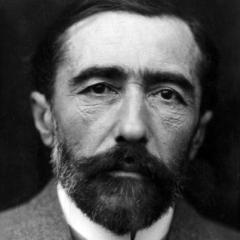
Author

Joseph Conrad
Joseph Conrad

Joseph Conrad, born on December 3, 1857 in Poland and died on August 3, 1924 in the United Kingdom, was a renowned British author of the late 19th and early 20th centuries. He is known for his profound descriptions of maritime life and his insightful explorations of human nature. more

You May Also Like

“A man that is of Copernicus’ Opinion, that this Earth of ours is a Planet, carry’d round and enlightn’d by the Sun, like the rest of them, cannot but sometimes have a fancy  …   that the rest of the Planets have their Dress and Furniture, nay and their Inhabitants too as well as this Earth of ours.… But we were always apt to conclude, that ’twas in vain to enquire after what Nature had been pleased to do there, seeing there was no likelihood of ever coming to an end of the Enquiry  …   but a while ago, thinking somewhat seriously on this matter (not that I count my self quicker sighted than those great Men [of the past], but that I had the happiness to live after most of them) me thoughts the Enquiry was not so impracticable nor the way so stopt up with Difficulties, but that there was very good room left for probable Conjectures.”

“That all plants immediately and substantially stem from the element water alone I have learnt from the following experiment. I took an earthern vessel in which I placed two hundred pounds of earth dried in an oven, and watered with rain water. I planted in it a willow tree weighing five pounds. Five years later it had developed a tree weighing one hundred and sixty-nine pounds and about three ounces. Nothing but rain (or distilled water) had been added. The large vessel was placed in earth and covered by an iron lid with a tin-surface that was pierced with many holes. I have not weighed the leaves that came off in the four autumn seasons. Finally I dried the earth in the vessel again and found the same two hundred pounds of it diminished by about two ounces. Hence one hundred and sixty-four pounds of wood, bark and roots had come up from water alone. (1648) [A diligent experiment that was quantitatively correct only as far as it goes. He overlooked the essential role of air and photosynthesis in the growth process]”

“[Concerning] phosphorescent bodies, and in particular to uranium salts whose phosphorescence has a very brief duration. With the double sulfate of uranium and potassium ... I was able to perform the following experiment: One wraps a Lumière photographic plate with a bromide emulsion in two sheets of very thick black paper, such that the plate does not become clouded upon being exposed to the sun for a day. One places on the sheet of paper, on the outside, a slab of the phosphorescent substance, and one exposes the whole to the sun for several hours. When one then develops the photographic plate, one recognizes that the silhouette of the phosphorescent substance appears in black on the negative. If one places between the phosphorescent substance and the paper a piece of money or a metal screen pierced with a cut-out design, one sees the image of these objects appear on the negative. One can repeat the same experiments placing a thin pane of glass between the phosphorescent substance and the paper, which excludes the possibility of chemical action due to vapors which might emanate from the substance when heated by the sun's rays. One must conclude from these experiments that the phosphorescent substance in question emits rays which pass through the opaque paper and reduces silver salts. [Although the sun is irrelevant, and he misinterprets the role of phosphorescence, he has discovered the effect of radioactivity.]”