Quotessence
Home / Quotes / Quote by Simone Weil

Quote by Simone Weil

Work

The Need for Roots: Prelude to a Declaration of Duties Towards Mankind

This book delves into the significance of having a sense of belonging and the responsibilities that arise from it, offering a profound look at the human condition and the obligations we hold towards one another and the world. more

Author
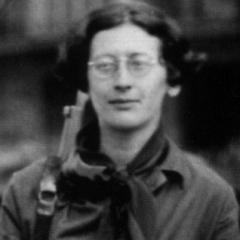
Simone Weil
Simone Weil

Simone Weil was a French philosopher, social activist, and writer. Born on February 3, 1909, and died on August 24, 1943, Weil is known for her profound philosophical thinking and her passionate commitment to social justice. Her works have had a significant impact on later philosophers and social thinkers. more

You May Also Like

“And anyway,” L3 went on, “who is the Maker but our own selves, really? Sure, some guy in a factory probably pieced me together originally, and someone else programmed me, so to speak. But then the galaxy itself forged me into who I am. Because we learn, Lando. We’re programmed to learn. Which means we grow. We grow away from that singular moment of creation, become something new with each changing moment of our lives—yes, lives— and look at me: these parts” — she ran her hand along the mesh wiring and the rebranded astromech of her midsection—“I did this. So maybe when we say The Maker we’re referring to the whole galaxy, or maybe we just mean ourselves. Maybe we’re our own makers, no matter who put the parts together.”

“It is certainly possible that an individual can, qua individual, suffer some failure of meaning, as in pathological boredom or depression. But any given social world is also a nexus of common significances, saliences, taboos, and a general shared orientation that can also either be sustained or can fail. Indeed one of the most interesting aspects of such a social condition, shared meaningfulness, or intelligibility, is that it can fail, go dead, lose its grip, and a very great deal of what interests Hegel is simply what such shared practical meaningfulness must be that it could fail, and how we should integrate our account of action into a fuller theory of the realization of such a condition and its failure. (His general name for the achievement and maintenance of such a form of intelligible life is “Sittlichkeit” and his case for this sort of priority of Sittlichkeit over strictly individualist accounts of mindedness in-action has not, I want to argue, been properly appreciated.)”

“You are so young, Lyra, too young to understand this, but I shall tell you anyway and you'll understand it later: men pass in front of our eyes like butterflies, creatures of a brief season. We love them; they are brave, proud, beautiful, clever; and they die almost at once. They die so soon that our hearts are continually racked with pain. We bear their children, who are witches if they are female, human if not; and then in the blink of an eye they are gone, felled, slain, lost. Our sons, too. When a little boy is growing, he thinks he is immortal. His mother knows he isn't. Each time becomes more painful, until finally your heart is broken. Perhaps that is when Yambe-Akka comes for you. She is older than the tundra. Perhaps, for her, witches' lives are as brief as men's are to us.”

“Idge says that there are moments when revolution is possible. Most of the time, we’re all – everyone, from the poorest beggar out there to the Patros on his golden throne – caught in the gears, controlled by these invisible forces, and if we act against them we’re crushed. But there are moments when things can change, when the forces balance and it’s possible for people – individual people – to make a big difference. To – realign things. Remake the world.”