Quotessence
Home / Quotes / Quote by Ken Wilber

Quote by Ken Wilber

“The difference between supermind and Big Mind (if we take Big Mind to mean the state experience of nondual Suchness, or turiyatita) is that Big Mind can be experienced or recognized at virtually any lower level or rung. Magic to Integral. In fact, one can be at, say, the Pluralistic stage, and experience several core characteristics of the entire sequence of state-stages (gross to subtle to causal to Witnessing to Nondual), although, of course, the entire sequence, including nondual Suchness, will be interpreted in Pluralistic terms. This is unfortunate in many ways—interpreting Dharma in merely Pluralistic terms (or Mythic terms, or Rational, and so on)—because it is so ultimately reductionistic; but it happens all the time, given the relative independence of states and structures at 1st and 2nd tier. Supermind, on the other hand, as a basic structure-rung (conjoined with nondual Suchness) can only be experienced once all the previous junior levels have emerged and developed, and as in all structure development, stages cannot be skipped. Therefore, unlike Big Mind, supermind can only be experienced after all 1st-, 2nd-, and 3rd-tier junior stages have been passed through. While, as Genpo Roshi has abundantly demonstrated, Big Mind state experience is available to virtually anybody at almost any age (and will be interpreted according to the View of their current stage), supermind is an extremely rare recognition. Supermind, as the highest structure-rung to date, has access to all previous structures, all the way back to Archaic—and the Archaic itself, of course, has transcended and included, and now embraces, every major structural evolution going all the way back to the Big Bang. (A human being literally enfolds and embraces all the major transformative unfoldings of the entire Kosmic history—strings to quarks to subatomic particles to atoms to molecules to cells, all the way through the Tree of Life up to its latest evolutionary emergent, the triune brain, the most complex structure in the known natural world.) Supermind, in any given individual, is experienced as a type of “omniscience”—the supermind, since it transcends and includes all of the previous structure-rungs, and inherently is conjoined with the highest nondual Suchness state, has a full and complete knowledge of all of the potentials in that person. It literally “knows all,” at least for the individual.”

Quote by Ken Wilber

Work

The Fourth Turning: Imagining the Evolution of an Integral Buddhism

This book delves into the philosophical and historical development of Integral Buddhism, analyzing its transformation and impact on society through its fourth stage of evolution. more

Author
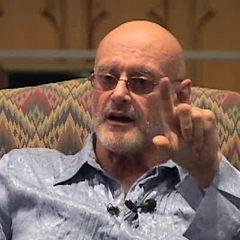
Ken Wilber
Ken Wilber

Ken Wilber is an American writer and philosopher, born on January 31, 1949. He is the founder of Integral Theory, which aims to integrate human knowledge, philosophy, psychology, and religion. Wilber's work covers a wide range of fields, including personal growth, spiritual development, and cultural studies. more

You May Also Like

“Finally, in terms of overall spiritual intelligence—which we have been briefly tracking—on the other side of the leading edge of evolution we have 3 or 4 higher, at this point mostly potential, levels of development, including levels of spiritual intelligence. Individually, their basic strcture-rungs are referred to as para-mind, meta-mind, overmind, and supermind; collectively, they are called 3rd tier. What all 3rd-tier structures have in common is some degree of direct transpersonal identity and experience. Further, each 3rd-tier structure of consciousness is integrated, in some fashion, with a particular state of consciousness (often, para-mental with the gross, meta-mental with subtle, overmind with causal/Witnessing, and supermind with nondual, although this varies with each individual’s actual history). Previously, in 1sst and 2nd tier, structures and states were relatively independent. One could have a state center of gravity at gross and yet structurally evolve all the way to Integral without fully objectifying the gross stage (i.e., fully making it an object, fully transcending it). But beginning with the 3rd-tier para-mind, whenever you experience that structure, you also implicitly or intuitively understand or experience the gross realm as objectified, which means that state is intimately connected to the structure at this level, which gives rise, or can give rise, to expanded states such as nature mysticism (this can be experienced at earlier levels but not inherently, and is interpreted according to the Views of those lower levels; but at this level becomes an inherent potential). Likewise, because of the conjunction with the gross state, this level often carries variations of the realization that the physical world is not merely physical, but is rather psychophysical in its true nature. This can also evoke flashes of higher state presences, such as Witnessing states or even nondual. And so on with the subtle state and meta-mind; causal/Witnessing and overmind; and nondual Suchness and supermind. Those states are all “minimally” connected to those structures, in the sesne that, for example, a person at meta-mind might have already and previously moved his or her state center of gravity to subtle, but if not, the person cannot proceed beyond the meta-mind without doing so at this point. And likewise with causal/Witnessing and overmind; and nondual Suchness and supermind.”

“In contrast, he describes spiritual transformation as an ‘established descent of the spiritual peace, light, knowledge, power, bliss from above, the awareness of the self and the divine and of a higher cosmic consciousness and the change of the whole consciousness to that’.18 The path to spiritual transformation leads the seeker through several experiences and realizations: temporary stages of peace, calm and silence; the discovery of the Self and its experience on various planes of consciousness; and experiences on the higher planes with its different layers—Higher Mind, Illumined Mind, Overmind. Not only to receive influences from these planes, but to actually live in them is, according to Sri Aurobindo, ‘a definite stage in the movement towards transformation’.19 Finally, we learn about the two main and alternating movements leading to spiritual transformation—the ascent of the lower consciousness towards the higher, and the descent of the higher, of peace, force, light and Ananda, into the lower to transform it. These and the experiences connected with them end this remarkable journey from the first opening of the inner veil to the psychic and spiritual transformation of all the planes and parts of the being, opening the gate to the essence and crown of Sri Aurobindo’s yoga: the supramental transformation.”

“With advanced quantum computational systems in place, we could have computed the COVID-19 vaccine within hours, if not minutes, of its discovery. Perhaps, any kind of life-threatening virus, since it is nothing more than a piece of code, will be completely preventable with the advances in quantum computing and computational biology. The question is, then, if we could eventually shield ourselves against the common viral micro-threat, what would a macro-threat of unknown nature mean for the human-machine civilization? We might soon need to decode another message from the transcendent realm edging us ever closer to the Cybernetic Singularity of some sort.”

“As biological beings, we humans - anchored to our biology - can only experience a thermodynamic arrow of time in one direction but given our rapid technological advances and the forthcoming Cybernetic Singularity, that might change for good. The ultimate effects of future developments may appear quite strange to us, present-day humans, as the emergence of things like personalized 'non-linear' reality and fluid distributed identity could challenge our current biological and cultural assumptions. The resulting 'identity' architectures will transform our notion of personhood and form the kernel of posthuman civilization.”

“When a philosopher happens to read some of his older texts, and most of the time he shakes his head in disapproval, he can be sure that he is on the right path. For this is an infallible sign that his thought has evolved and that he possesses the capacity to learn, to unlearn, to adapt. He is brave enough to acknowledge that he may have been naive, and this, at the same time, is a useful reminder that he might be wrong even with his current views. Thus, he protects himself against arrogance and intransigence.”

“As also noted by Morris, empirical data from various lineages of fish and amphibians have shown, for instance, that more plastic clades tend to be more speciose than sister taxa of similar age but with less plasticity, due to a combination of greater opportunities to diversify and augmented evolvability of plastic features and thus of decreased risk of extinction. In addition, empirical studies show that even populations that derive from ancestors that were particularly overspecialized for a certain, very specific way of life, including parasitism, have successfully changed their behavior by becoming non-parasitic and displaying a morphology that is substantially different from that of their ancestors as seen for example in lamprey evolution. Morris argued that random variations arising in a population may decrease plasticity and that the plastically changed phenotype linked with the behavioral shift may be negatively affected. Therefore, these variants will be likely eliminated by selection, whereas variants that decrease plasticity in the direction of the plastic change will tend to be selected and spread through the population. This may lead to a situation in which the phenotype might appear similar across generations, but its plasticity is actually increasingly reduced until an environmental shift will no longer provoke phenotypic changes. As noted by Morris, Baldwin allowed for other non-mutually exclusive scenarios to occur, such as the rise of variants that increase plasticity in general, thus increasing the ‘fit’ between organisms and their environment and the degree to which evolution could be directed, thus leading to evolutionary trends.”

“The realization that the brain used so many different kind of chemicals, in addition to classical neurotransmitters, to communicate beween neurons was just the first step in a major conceptual shift in neuroscience. Many of these substances are neuropeptides, and most of those affect mood and behavior. The specificity of their effects resides not in the anatomical connectivity between neurons, but in the distribution of receptors within the brain. Different receptors have very different patterns of distribution, and the distributions differ between species in ways that correlate with differences in behavior. The mere fact of a receptor-peptide mismatch in a particular brain area might have no great importance. It might be that many cells are promiscuous in the receptors that they express: If some receptors see no ligand, the cost to the cells is negligible. Profligate receptor expression might contribute to the evolvability of neural systems, and might be common because organisms with a liberal attitude to receptor expression are those most likely to acquire novels functions. Because extrasynaptic signaling does not require precise point-to-point connectivity, it is intrinsically 'evolvable': a minor mutation in the regulatory region of a peptide receptor gene, by altering the expression pattern, could have functional consequences without any need for anatomical rewiring. That peptide receptors have distinctive patterns of expression, and that peptides produce coherent behavioral effects when given quite crudely into the brain, suggests that volume transmission is used as a signaling mechanism by many different populations of peptidergic neurons. We thus must see neuropeptides as 'hormones of the brain'.”

“Some foolish men declare that creator made the world. The doctrine that the world was created is ill advised and should be rejected. If God created the world, where was he before the creation? If you say he was transcendent then and needed no support, where is he now? How could God have made this world without any raw material? If you say that he made this first, and then the world, you are faced with an endless regression. If you declare that this raw material arose naturally you fall into another fallacy, For the whole universe might thus have been its own creator, and have arisen quite naturally. If God created the world by an act of his own will, without any raw material, then it is just his will and nothing else — and who will believe this silly nonsense? If he is ever perfect and complete, how could the will to create have arisen in him? If, on the other hand, he is not perfect, he could no more create the universe than a potter could. If he is form-less, action-less and all-embracing, how could he have created the world? Such a soul, devoid of all morality, would have no desire to create anything. If he is perfect, he does not strive for the three aims of man, so what advantage would he gain by creating the universe? If you say that he created to no purpose because it was his nature to do so, then God is pointless. If he created in some kind of sport, it was the sport of a foolish child, leading to trouble. If he created because of the karma of embodied beings [acquired in a previous creation] He is not the Almighty Lord, but subordinate to something else. If out of love for living beings and need of them he made the world, why did he not take creation wholly blissful free from misfortune? If he were transcendent he would not create, for he would be free: Nor if involved in transmigration, for then he would not be almighty. Thus the doctrine that the world was created by God makes no sense at all, And God commits great sin in slaying the children whom he himself created. If you say that he slays only to destroy evil beings, why did he create such beings in the first place? Good men should combat the believer in divine creation, maddened by an evil doctrine. Know that the world is uncreated, as time itself is, without beginning or end, and is based on the principles, life and rest. Uncreated and indestructible, it endures under the compulsion of its own nature. [By 9th century Jain (the religion of Jainism) Acharya, Jinasena, in his work, Mahapurana, a major Jain text. The Jains have never believed in any gods as creators of the universe, unlike most other religions, and have focused on acting morally on Earth rather than wasting time supplicating the supernatural.]”