“I'm all these words, all these strangers, this dust of words, with no ground for their settling, no sky for their dispersing, coming together to say, fleeing one another to say, that I am they, all of them, those that merge, those that part, those that never meet, and nothing else, yes, something else, that I'm something quite different, a quite different thing, a wordless thing in an empty place, a hard shut dry cold black place, where nothing stirs, nothing speaks, and that I listen, and that I seek, like a caged beast born of caged beasts born of caged beasts born of caged beasts born in a cage and dead in a cage, born and then dead, born in a cage and then dead in a cage, in a word like a beast, in one of their words, like such a beast, and that I seek, like such a beast, with my little strength, such a beast, with nothing of its species left but fear and fury, no, the fury is past, nothing but fear, nothing of all its due but fear centupled, fear of its shadow, no, blind from birth, of sound then, if you like, we'll have that, one must have something, it's a pity, but there it is, fear of sound, fear of sounds, the sounds of beasts, the sounds of men, sounds in the daytime and sounds at night, that's enough, fear of sounds all sounds, more or less, more or less fear, all sounds, there's only one, continuous, day and night, what is it, it's steps coming and going, it's voices speaking for a moment, it's bodies groping their way, it's the air, it's things, it's the air among the things, that's enough, that I seek, like it, no, not like it, like me, in my own way, what am I saying, after my fashion, that I seek, what do I seek now, what it is, it must be that, it can only be that, what it is, what it can be, what what can be, what I seek, no, what I hear, I hear them, now it comes back to me, they say I seek what it is I hear, I hear them, now it comes back to me, what it can possibly be, and where it can possibly come from, since all is silent here, and the walls thick, and how I manage, without feeling an ear on me, or a head, or a body, or a soul, how I manage, to do what, how I manage, it's not clear, dear dear, you say it's not clear, something is wanting to make it clear, I'll seek, what is wanting, to make everything clear, I'm always seeking something, it's tiring in the end, and it's only the beginning.”
Quote by Samuel Beckett
Book:The Unnamable
Work
The Unnamable
This book explores profound themes of self-discovery and the elusive nature of personal identity, offering readers a thought-provoking narrative that challenges conventional perceptions of self and society. more
Author
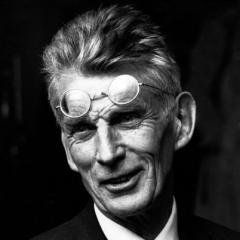
Samuel Beckett
Samuel Beckett was an Irish novelist, playwright, and poet, widely regarded as one of the most influential writers of the 20th century. His works are characterized by their minimalist style, existential themes, and use of language. His most famous works include 'Waiting for Godot' and 'Molloy'. Beckett was awarded the Nobel Prize in Literature in 1969. more
You May Also Like
Source: Normal People
Source: Jesus > Religion: Why He Is So Much Better Than Trying Harder, Doing More, and Being Good Enough
Source: The Enchantress of Florence
Source: The Thing About Jellyfish
Source: Silence
Source: Coilhunter
Source: Better Off Friends