Quotessence
Home / Quotes / Quote by Friedrich Nietzsche

Quote by Friedrich Nietzsche

Work

Human, All Too Human: A Book for Free Spirits

This book is a compilation of essays that delve into the complexities of human existence, focusing on the essence of free spirits and their place in the world. It offers insights into the human psyche, the pursuit of knowledge, and the search for meaning. more

Author
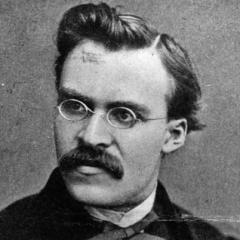
Friedrich Nietzsche
Friedrich Nietzsche

Friedrich Nietzsche was a German philosopher, cultural critic, poet, and writer whose works have had a profound impact on subsequent philosophy, literature, and thought. His ideas revolve around concepts such as the 'will to power', the 'Übermensch', and the 'eternal recurrence'. more

You May Also Like

“Great paintings—people flock to see them, they draw crowds, they’re reproduced endlessly on coffee mugs and mouse pads and anything-you-like. And, I count myself in the following, you can have a lifetime of perfectly sincere museum-going where you traipse around enjoying everything and then go out and have some lunch. But if a painting really works down in your heart and changes the way you see, and think, and feel, you don’t think, ‘oh, I love this picture because it’s universal.’ ‘I love this painting because it speaks to all mankind.’ That’s not the reason anyone loves a piece of art. It’s a secret whisper from an alleyway. Psst, you. Hey kid. Yes you. An individual heart-shock. Your dream, Welty’s dream, Vermeer’s dream. You see one painting, I see another, the art book puts it at another remove still, the lady buying the greeting card at the museum gift shop sees something else entire, and that’s not even to mention the people separated from us by time—four hundred years before us, four hundred years after we’re gone—it’ll never strike anybody the same way and the great majority of people it’ll never strike in any deep way at all but—a really great painting is fluid enough to work its way into the mind and heart through all kinds of different angles, in ways that are unique and very particular. Yours, yours. I was painted for you. And—oh, I don’t know, stop me if I’m rambling… but Welty himself used to talk about fateful objects. Every dealer and antiquaire recognizes them. The pieces that occur and recur. Maybe for someone else, not a dealer, it wouldn’t be an object. It’d be a city, a color, a time of day. The nail where your fate is liable to catch and snag.”

“Let us seek the respite where it is—in the very thick of battle. For in my opinion, and this is where I shall close, it is there. Great ideas, it has been said, come into the world as gently as doves. Perhaps then, if we listen attentively, we shall hear, amid the uproar of empires and nations, a faint flutter of wings, the gentle stirring of life and hope. Some will say that this hope lies in a nation; others, in a man. I believe rather that it is awakened, revived, nourished by millions of solitary individuals whose deeds and works every day negate frontiers and the crudest implications of history. As a result, there shines forth fleetingly the ever threatened truth that each and every man, on the foundation of his own suffering and joys, builds for all.”

“If you ask today what art is, what its function is, what the meaning of art is and why one should create art, the answer given oftentimes by Western philosophers of art and those who special- ize in modern aesthetics is ‘‘art for art’s sake.’’ The modern response is that you just create art for the sake of art; but this was never the answer of traditional civilizations where one created art for both the sake of attainment of inner perfection and for human need in the deepest sense—because the needs of man are not only physical, they are also spiritual. We are as much in need of beauty as of the air that we breathe.”

“You want to feel that you belong to something higher, to something even beyond this universe, then go to the opera!”