Quotessence
Home / Quotes / Quote by Bayard Rustin

Quote by Bayard Rustin

Author

Bayard Rustin
Bayard Rustin

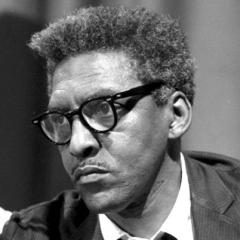
Bayard Rustin was a prominent African American civil rights activist who played a significant role in the American civil rights movement. He was a strategist and advisor to many civil rights leaders, including Martin Luther King Jr. Rustin was a key figure in the organization of the 1963 March on Washington for Jobs and Freedom, one of the largest political protests in U.S. history. He was also a leader in the gay rights movement and advocated for nonviolent protest and civil disobedience. more

You May Also Like

“If any think that their influence would be lost there, and their voices no longer afflict the ear of the State, that they would not be as an enemy within its walls, they do not know how much truth is stronger than errors, nor how much more eloquently and effectively he can combat injustice who has experienced a little in his own person. Cast your whole vote, not a strip of paper merely, but your whole influence.”

“The leaders and followers of the Harlem Renaissance were every bit as intent on using Black culture to help make the United States a more functional democracy as they were on employing Black culture to 'vindicate' Black people.”

“A final victory is an accumulation of many short-term encounters. To lightly dismiss a success because it does not usher in a complete order of justice is to fail to comprehend the process of full victory. It underestimates the value of confrontation and dissolves the confidence born of partial victory by which new efforts are powered.”

“Another site of Leftist struggle [other than Detroit] that has parallels to New Orleans: Palestine. From the central role of displacement to the ways in which culture and community serve as tools of resistance, there are illuminating comparisons to be made between these two otherwise very different places. In the New Orleans Black community, death is commemorated as a public ritual (it's often an occasion for a street party), and the deceased are often also memorialized on t-shirts featuring their photos embellished with designs that celebrate their lives. Worn by most of the deceased's friends and family, these t-shirts remind me of the martyr posters in Palestine, which also feature a photo and design to memorialize the person who has passed on. In Palestine, the poster's subjects are anyone who has been killed by the occupation, whether a sick child who died at a checkpoint or an armed fighter killed in combat. In New Orleans, anyone with family and friends can be memorialized on a t-shift. But a sad truth of life in poor communities is that too many of those celebrate on t-shirts lost their lives to violence. For both New Orleans and Palestine, outsiders often think that people have become so accustomed to death by violence that it has become trivialized by t-shirts and posters. While it's true that these traditions wouldn't manifest in these particular ways if either population had more opportunities for long lives and death from natural causes, it's also far from trivial to find ways to celebrate a life. Outsiders tend to demonize those killed--especially the young men--in both cultures as thugs, killers, or terrorists whose lives shouldn't be memorialized in this way, or at all. But the people carrying on these traditions emphasize that every person is a son or daughter of someone, and every death should be mourned, every life celebrated.”

“But we need to search for and find, what we need to own and perfect into a magnificent, shining thing, is a new kind of politics. Not the politics of governments, but the politics of resistance. The politics of opposition. The politics of forcing accountability. The politics of slowing things down. In the present circumstances, I'd say the only thing worth globalizing is dissent.”