Quotessence
Home / Quotes / Quote by Homer

Quote by Homer

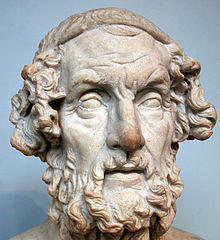
“But when he spoke, that great voice of his poured out of his chest in words like the snowflakes of winter, and then no other mortal could in debate contend with Odysseus. Nor did we care any longer how he looked.”
Quote by Homer

Work

The Iliad

An ancient Greek epic, The Iliad, narrates the events of the Trojan War, focusing on the conflict between the Greeks and the Trojans, particularly the story of the warrior Achilles. more

Author

Homer
Homer

Homer, according to limited information, was an ancient Greek poet, credited with authorship of the epic poems 'The Iliad' and 'The Odyssey'. His biography is not well-documented, with the exact dates of his birth and death unknown. His works have had a profound impact on Western literature. more

You May Also Like

“All words have to be coined by a wordsmith at some point in the mists of history. The wordsmith had an idea to get across and needed a sound to express it. In principle, any sound would have done - basic principle of linguistics is that the relation of a sound to a meaning is arbitrary - so the first coiner of a term from for a political affiliation, for instance, could have used glorg or schmendrick or mcgillicuddy. But people are poor at conjuring sounds out of the blue, and they probably wanted to ease their listeners understanding of the coinage rather than having to define it or illustrate it with examples. So they reached for a metaphor that reminded them of the idea and they hoped would evoke a similar idea in the minds of their listeners, such as band or bond for a political affiliation. The metaphorical hint allowed the listeners to cotton on to the meaning more quickly than if they had had to rely on context alone, giving the word an advantage in the Darwinian competition among neologisms […] The word spread and became endemic to the community, adding to the language’s stock of apparent metaphors. But then it came to be used often enough, and in enough contexts, the speakers kicked the ladder away, and today people think not a whit about the metaphorical referent. It persists as a semantic fossil, a curiosity to amuse etymologists and wordwatchers [stet], but with no more resonance in our minds than any other string of vowels and consonants.”