Quotessence
Home / Quotes / Quote by Matthieu Ricard

Quote by Matthieu Ricard

“To end suffering - not only by relieving its symptoms but by eradicating its root cause - is precisely the aim of the Buddha's teaching. We must first realize that the true cause of suffering is not outside, but inside. That is why true spiritual practice consists of working on one's own mind. The mind is very powerful. It can create happiness or suffering, heaven or hell. If, with the help of the Dharma, you manage to eliminate your inner poisons, nothing from outside will ever affect your happiness, but as long as those poisons remain in your mind, you will not find the happiness you seek anywhere in the world. (Nyoshul Khen Rinpoche)”

Quote by Matthieu Ricard

Work

Author

Matthieu Ricard
Matthieu Ricard

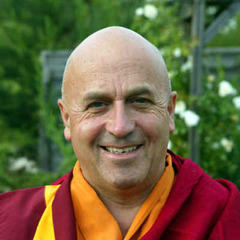
Matthieu Ricard is a French-born Tibetan Buddhist monk and a renowned scientist. Born on February 15, 1946, he has made significant contributions to the fields of Buddhist philosophy and scientific research. more

You May Also Like

“Whether or not you go in a positive direction depends entirely on you. You have to be your own teacher and try to figure out what it takes to accomplish your goals. You have to be your own judge and try to get yourself to do the right thing and stop yourself from doing the wrong thing. Take responsibility for yourself. (17th Karmapa)”

“Do not waste a single moment, like a warrior who, pierced to the heart by an arrow, knows he has only few minutes to live. It is now, while we are in good health and in possession of all our physical and mental faculties, that we should practice dharma.”

“You should understand the whole purpose of listening to teachings, taking teachings and studying them is to put them into practice. What you know should be put into practice immediately; you can thus derive the benefit of having some transformation within your mind. Even though it might be a very minor effort, a very small practice just leaving imprints within your mind, still you must think that it is worthwhile to do. Otherwise your knowledge of dharma will be quite fruitless.”

“Do like this if you want to practice the true Dharma! Keep your master's oral instructions in mind. Don't conceptualize your experience, as it just makes you attached or angry. Day and night, look into your mind. If your stream of mind contains any nonvirtue, renounce it from the core of your heart and pursue virtue. (p. 29)”

“When you listen carefully to this and put it correctly into practice, you will certainly automatically receive the blessings! When you assimilate loving kindness in you heart, you will be loved by all beings. When you hold compassion in your heart, everyone will cherish you as their own child. When you keep impartiality in your heart, you will be free from enmity and prejudice. When you fill your heart with sympathetic joy, your actions will be in harmony with everyone. When you give up the thought of harming others, you will meet less hostility. When you tame your mind and are very generous, many followers will gather around you. (p. 107)”

“What you‘re experiencing now is conditioned and determined by your past; what you‘re doing now conditions and determines what you‘ll see in your future. When you can take responsibility for that causal process, you are on the first stage of the hero path. You change your piece of the world by changing your body and mind from that of an ordinary, deluded, sleepwalking, and afflicted human to that of a hero and eventually a Buddha – one who is utterly awake. Then you inspire others, until everyone‘s piece of the world is utterly, collectively transformed. (pp. 88 - 89)”

“It is important to be able to differentiate between two levels of understanding. One is the superficial, intellectual level, where on the basis of reading, studying or listening to teachings, we distinguish between negative and positive qualities of mind and recognize their nature and origin. The other is the deeper, experiential level, where we actually cultivate and generate positive qualities within ourselves. Although it can be challenging to develop an intellectual understanding of certain topics, it is generally easier because it can be cultivated merely by reading texts or listening to teachings. Experiential understanding is far more difficult to develop, since it comes about only as a result of sustained practice. At the experiential level, your understanding is also accompanied by a strong component of feeling; your understanding is essentially a felt experience.”

“The Tibetan term for Dharma is chö, which has the literal connotation of “changing,” or “bringing about transformation.” When we talk about transforming the mind, we are referring to the task of diminishing the force of destructive thoughts and emotions while developing the force of those that are constructive and beneficial. In this way, through the practice of Dharma, we transform our undisciplined mind into one that is disciplined.”