Quotessence
Home / Quotes / Quote by Fyodor Dostoevsky

Quote by Fyodor Dostoevsky

“And who knows (there is no saying with certainty), perhaps the only goal on earth to which mankind is striving lies in this incessant process of attaining, in other words, in life itself, and not in the thing to be attained, which must always be expressed as a formula, as positive as twice two makes four, and such positiveness is not life, gentlemen, but is the beginning of death. Anyway, man has always been afraid of this mathematical certainty, and I am afraid of it now. Granted that man does nothing but seek that mathematical certainty, he traverses oceans, sacrifices his life in the quest, but to succeed, really to find it, dreads, I assure you.”

Quote by Fyodor Dostoevsky

Work

Notes from the Underground

Browse quotes and source details for this work. more

Author
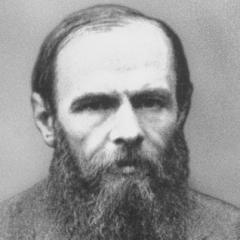
Fyodor Dostoevsky
Fyodor Dostoevsky

A renowned Russian novelist and a pioneer of psychological novels. His works deeply reveal the complexity of human nature and the injustice of society, having a profound impact on literature worldwide. more

You May Also Like

“there are continually turning up in life moral and rational persons, sages and lovers of human- ity who make it their object to live all their lives as morally and rationally as possible, to be, so to speak, a light to their neighbours simply in order to show them that it is possible to live morally and rationally in this world. And yet we all know that those very people sooner or later have been false to themselves, playing some queer trick, o en a most un- seemly one. Now I ask you: what can be expected of man since he is a being endowed with strange qualities? Show- er upon him every earthly blessing, drown him in a sea of happiness, so that nothing but bubbles of bliss can be seen Free eBooks at Planet eBook.com on the surface; give him economic prosperity, such that he should have nothing else to do but sleep, eat cakes and busy himself with the continuation of his species, and even then out of sheer ingratitude, sheer spite, man would play you some nasty trick. He would even risk his cakes and would deliberately desire the most fatal rubbish, the most uneco- nomical absurdity, simply to introduce into all this positive good sense his fatal fantastic element. It is just his fantastic dreams, his vulgar folly that he will desire to retain, simply in order to prove to himself—as though that were so neces- sary— that men still are men and not the keys of a piano, which the laws of nature threaten to control so completely that soon one will be able to desire nothing but by the cal- endar. And that is not all: even if man really were nothing but a piano-key, even if this were proved to him by natural science and mathematics, even then he would not become reasonable, but would purposely do something perverse out of simple ingratitude, simply to gain his point. And if he does not nd means he will contrive destruction and chaos, will contrive su erings of all sorts, only to gain his point! He will launch a curse upon the world, and as only man can curse (it is his privilege, the primary distinction be- tween him and other animals), may be by his curse alone he will attain his object—that is, convince himself that he is a man and not a piano-key! If you say that all this, too, can be calculated and tabulated—chaos and darkness and curses, so that the mere possibility of calculating it all be- forehand would stop it all, and reason would reassert itself, then man would purposely go mad in order to be rid of rea- 0 Notes from the Underground son and gain his point! I believe in it, I answer for it, for the whole work of man really seems to consist in nothing but proving to himself every minute that he is a man and not a piano-key! It may be at the cost of his skin, it may be by can- nibalism! And this being so, can one help being tempted to rejoice that it has not yet come o , and that desire still de- pends on something we don’t know?”