Quotessence
Home / Quotes / Quote by Omar Khayyam

Quote by Omar Khayyam

Work

Rubáiyát of Omar Khayyám

The Rubáiyát of Omar Khayyám is a compilation of the poet's quatrains, reflecting his philosophical and spiritual musings. These poems, written in Persian, have been celebrated for their wit, wisdom, and lyrical beauty. The work explores themes of love, life, death, and the nature of the universe. more

Author
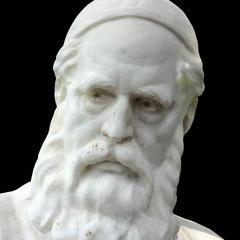
Omar Khayyam
Omar Khayyam

Omar Khayyam was a Persian philosopher, mathematician, and poet, renowned for his contributions to algebra and his philosophical works, particularly the 'Quatrains', which have had a profound influence on Western literature and thought. more

You May Also Like

“The graphics of Israeli life, death, and detention are more vibrant; it conforms to the norm of human life already established, is then more of a life, is life, whereas Palestinian life is either no life, a shadow-life, or a threat to life as we know it. In this last form, it has undergone a full transformation into arsenal or spectral threat, figuring an infinite threat against which a limitless “defense” formulates itself. That defense without limit then embodies the principles of attack without limit (without shame, and without regard for established international protocols regarding war crimes).”

“My grandfather was a voyageur, and lived to be of great age,” recalled “Old” Pierre, “and [he] told me the stories of the wild Indians of those days, and our brave French Canadians who were a match for them. There was a great man of whom he used to speak much, Monsieur de Langlade. […] My grandfather told me that when Langlade was a child about seven years of age, there was a war raging between the Ottawas, many of whom lived at Michilimackinac, and another tribe allied to the English. Twice the young men of the Ottawas had gone forth to attack a village of the enemy, and each time had they been driven back. The French officer at the fort urged them to make the attack again. The Ottawas were not willing. At last, their chief said that he had had a dream; that in the dream he saw a fight; that the young Langlade was there; and that in his dream the Ottawas seemed to win the day. The dream gave the young men courage on its being told them. They must be accompanied by the child Langlade, and they would go upon the war-path once more. The father Langlade, at first unwilling, at last agreed, but only on a pledge given by the boy that he would never disgrace his father by being a coward. The Ottawas were now ready to go forth; they advanced with the terrible war-cries of the [Natives]; inspired by the recollection of the dream and the presence of the boy, they gained the day […]. The young Langlade was now held in great honor; they said he was no doubt preserved by a mighty Manitou [“Great Spirit”].”

“Indeed, so prevalent had his leadership on the battlefield been that day, that Langlade was jointly proclaimed “Ake-wauge-ketausa”, or “Military Conqueror”, by his Indigenous brethren, with the literal translation of his title meaning “He Who is Fierce for the Land”, although an alternative spelling of “Auke-winge-ketaw-so”, meaning “Defender of his Country” is also recorded. However, to the Menomonee (Folles Avoines) specifically, he was simply known henceforth as the “Bravest of the Brave.”

“The Great Superstition (Sonnet) Fundamentalists radicalize children for illegal terrorism, nationalists radicalize children for legal terrorism, I radicalize children for peace-n-oneness, using only their brain and backbone, without spilling the blood of human. Only leeches live by guns and call it honor, brainwashed by the witchcraft of patriotism. Fundamentalism, nationalism, these are the real witchcraft, still practiced by modern savages. Teachers, coppers, politicians, civil servants, all (most) mindlessly carry the paradigm of death. Give me a hundred humanitarian hearts, I'll wipe out the very concept of war. Pack your flags with other talismans, there is no greater superstition than the superstition of nation.”