Quotessence
Home / Quotes / Quote by Martin Luther

Quote by Martin Luther

“How much less, then, is the disorder to be tolerated that arises when a Christian leaves his office and takes upon him a temporal office, or when a bishop or pastor leaves his office and takes upon him the office of a prince or judge; or, on the other hand, when a prince takes up the office of a bishop and lets his princely office go? Even today this shameful disorder rages and rules in the whole papacy, contrary to their own canons and laws.”

Quote by Martin Luther

Work

On War Against the Turk

Browse quotes and source details for this work. more

Author
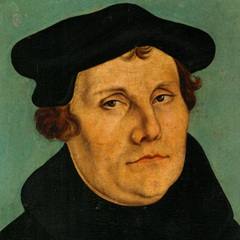
Martin Luther
Martin Luther

Martin Luther, born on November 10, 1483 and died on February 18, 1546, was a significant figure in the German Reformation. He was a monk, theologian, philosopher, and writer, known for his leading role in the Reformation. Luther challenged the authority of the Roman Catholic Church and translated the Bible into German, which had a profound impact on German culture and religion. more

You May Also Like

“The enemies of Christ from Nero to Napoleon eventually discovered that to attack or murder the pope only creates sympathy and martyrs. It is a failed strategy in every era. So instead, they sought quietly to place one of their own in the papal shoes. It would require decades, even a century, to create the seminaries, the priests, the bishops, the cardinal electors, and then even the pope or popes themselves — but it would be worth the wait. It has been a slow, patient plan to establish a Satanic revolution with the pope as puppet.”

“All Protestants are Crypto-Papists,’ wrote the Russian theologian Alexis Khomiakov to an English friend in the year 1846. ‘ . . . To use the concise language of algebra, all the West knows but one datum a; whether it be preceded by the positive sign +, as with the Romanists, or with the negative − as with the Protestants, the a remains the same. Now a passage to Orthodoxy seems indeed like an apostasy from the past, from its science, creed, and life. It is rushing into a new and unknown world.’ Khomiakov, when he spoke of the datum a, had in mind the fact that western Christians, whether Free Churchmen, Anglicans, or Roman Catholics, have a common background in the past. All alike (although they may not always care to admit it) have been profoundly influenced by the same events: by the Papal centralization and the Scholasticism of the Middle Ages, by the Renaissance, by the Reformation and Counter-Reformation, and by the Enlightenment. But behind members of the Orthodox Church — Greeks, Russians, and the rest — there lies a very different background. They have known no Middle Ages (in the western sense) and have undergone no Reformations or Counter-Reformations; they have only been affected in an oblique way by the cultural and religious upheaval which transformed western Europe in the sixteenth and seventeenth centuries. Christians in the west, both Roman and Reformed, generally start by asking the same questions, although they may disagree about the answers. In Orthodoxy, however, it is not merely the answers that are different — the questions themselves are not the same as in the west. (p.1–2)”

“Jane Austen’s Pride and Prejudice should create in the discerning male reader a deeply rooted concupiscence for Elizabeth Bennet that springs not from her vivacity or from her wit but from her unerring instinct to follow the deeply moral directives of her own character even against the influences and arguments of society, of convention, of seeming necessity, and of her friends and family. Properly read, Austen should be a form of pornography for the morally and spiritually discriminating man.”

“As we plant in tears, we shall harvest with joy.”

“Giving is the only way to receive more.”