Quotessence
Home / Authors / Douglas Rushkoff
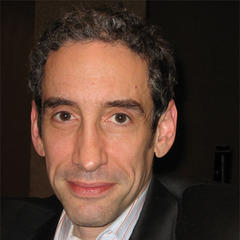
Douglas Rushkoff

Douglas Rushkoff Quotes

Writer

Filter quotes by topic

Famous Douglas Rushkoff Quotes

“Our digital devices and the outlooks they inspired allowed us to break free of the often repressive timelines of our storytellers, turning us from creatures led about by future expectations into more fully present-oriented human beings. The actual experience of this now-ness, however, is a bit more distracted, peripheral, even schizophrenic than that of being fully present. For many, the collapse of narrative led initially to a kind of post-traumatic stress disorder—a disillusionment, and the vague unease of having no direction from above, no plan or story. But like a dose of adrenaline or a double shot of espresso, our digital technologies compensate for this goalless drifting with an onslaught of simultaneous demands. We may not know where we're going anymore, but we're going to get there a whole lot faster. Yes, we may be in the midst of some great existential crisis, but we're simply too busy to notice.”

“Meanwhile, people are busy using fractals to explain any system that has defied other, more reductionist approaches. Since they were successfully applied by IBM's Benoit Mandlebrot to the problem of seemingly random, intermittent interference on the phone lines, fractals have been used to identify underlying patterns in weather systems, computer files, and bacteria cultures. Sometimes fractal enthusiasts go a bit too far, however, using these nonlinear equations to mine for patterns in systems where none exist. Applied to the stock market to consumer behavior, fractals may tell less about those systems than about the people searching for patterns within them. There is a dual nature to fractals: They orient us while at the same time challenging our sense of scale and appropriateness. They offer us access to the underlying patterns of complex systems while at the same time tempting us to look for patterns where none exist. This makes them a terrific icon for the sort of pattern recognition associated with present shock—a syndrome we'll call factalnoia. Like the robots on Mystery Science Theater 3000, we engage by relating one thing to another, even when the relationship is forced or imagined. The tsunami makes sense once it is connected to chemtrails, which make sense when they are connected to HAARP. It's not just conspiracy theorists drawing fractalnoid connections between things. In a world without time, any and all sense making must occur on the fly. Simultaneity often seems like all we have. That's why anyone contending with present shock will have a propensity to make connections between things happening in the same moment—as if there had to be an underlying logic.”

“Meanwhile, the extraordinary measures we take to stay abreast of each minuscule change to the data stream end up magnifying the relative importance of these blips to the real scheme of things. Investors trade, politicians respond, and friends judge based on the micromovements of virtual needles. By dividing our attention between our digital extensions, we sacrifice our connection to the truer present in which we are living. The tension between the faux present of digital bombardment and the true now of a coherently living human generated the second kind of present shock, what we're calling digiphrenia—digi for "digital," and phrenia for "disordered condition of mental activity.”

“What happens when those of us living at the pace of fashion try to insert an awareness of these much larger cycles into our everyday activity? In other words, what's it like to envision the ten-thousand-year impact of tossing that plastic bottle into the trash bin, all in the single second it takes to actually toss it? Or the ten-thousand-year history of the fossil fuel being burned to drive to work or iron a shirt? It may be environmentally progressive, but it's not altogether pleasant. Unless we're living in utter harmony with nature, thinking in ten-thousand-year spans is an invitation to a nightmarish obsession. It's a potentially burdensome, even paralyzing, state of mind. Each present action becomes a black hole of possibilities and unintended consequences. We must walk through life as if we had traveled in to the past, aware that any change we make—even moving an ashtray two inches to the left—could ripple through time and alter the course of history. It's less of a Long Now than a Short Forever. This weight on every action—this highly leveraged sense of the moment—hints at another form of present shock that is operating in more ways and places than we may suspect. We'll call this temporal compression overwinding—the effort to squish really big timescales into much smaller or nonexistent ones. It's the effort to make the "now" responsible for the sorts of effects that actually take real time to occur—just like overwinding a watch in the hope that it will gather up more potential energy and run longer than it can.”