Quotessence
Home / Authors / E. Haldeman-Julius
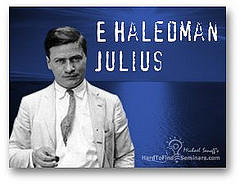
E. Haldeman-Julius

E. Haldeman-Julius Quotes

Writer

Filter quotes by topic

Famous E. Haldeman-Julius Quotes

“Atheism is a conclusion reached by the most reasonable methods and one which is not asserted dogmatically but is explained in its every feature by the light of reason. The atheist does not boast of knowing in a vainglorious, empty sense. He understands by knowledge the most reasonable and clear and sound position one can take on the basis of all the evidence at hand. This evidence convinces him that theism is not true, and his logical position, then, is that of atheism. We repeat that the atheist is one who denies the assumptions of theism. he asserts, in other words, that he doesn't believe in a God because he has no good reason for believing in a God. That's atheism -- and that's good sense.”

“We advocate the atheistic philosophy because it is the only clear, consistent position which seems possible to us. As atheists, we simply deny the assumptions of theism; we declare that the God idea, in all its features, is unreasonable and unprovable; we add, more vitally, that the God idea is an interference with the interests of human happiness and progress. We oppose religion not merely as a set of theological ideas; but we must also oppose religion as a political, social and moral influence detrimental to the welfare of humanity.”

“Fortunately, there are old terrors and powers that religion no longer can exercise so effectively as it did only a few score years ago. But the atmosphere and the attitude of bigotry remain. If religion cannot ordinarily invoke the armed force of law to punish heretics, it still plays upon the psychology of fear and predominantly its influence is to frighten men and distort their views and poison every process of their reasoning.”

“The church has contributed nothing to civilization. It has progressed somewhat, and it has become a little more decent, in reflection of the movements of civilization that have taken place outside of the church and usually in the face of the strong opposition of the church. But the church has always resisted the process of civilization. It has struggled to the last ditch, by fair means and foul, to preserve as long as it could the vestiges of ancient and medieval theology, with all the puerile moralities and harsh customs and medieval styles of belief.”