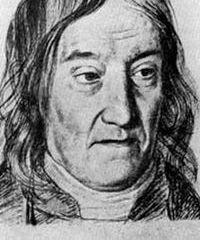
Farkas Bolyai was a Hungarian mathematician renowned for his pivotal contributions to mathematics, especially in the realm of non-Euclidean geometry. Born on February 9, 1775, in Kolozsvár, Hungary, and passing away on November 20, 1856, in Marosvásárhely, Hungary, Bolyai's work fundamentally altered the understanding of geometry. His discovery of non-Euclidean geometry, presented in his posthumously published work 'Über die Egale Vertheilung der Linien in einem Raume,' challenged the established Euclidean parallel postulate and paved the way for the development of hyperbolic geometry.