Quotessence
Home / Authors / Gerald Holton
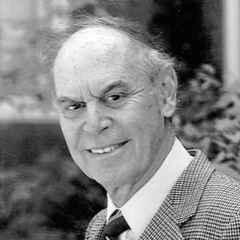
Gerald Holton

Gerald Holton Quotes

Physics researcher

Filter quotes by topic

Famous Gerald Holton Quotes

“The unsolved problems of the physical world now seem even more formidable than those solved in the twentieth century. Though in application it works splendidly, we do not even understand the physical meaning of quantum mechanics, much less how it might be united with general relativity. We don't know why the dimensionless constants (ratios of masses of elementary particles, ratios of strength of gravitational to electric forces, fine structure constant, etc.) have the values they do, unless we appeal to the implausible anthropic principle, which seems like a regression to Aristotelian teleology.”

“The power of the deductive network produced in physics has been illustrated in a delightful article by Victor F. Weisskopf. He begins by taking the magnitudes of six physical constants known by measurement: the mass of the proton, the mass and electric charge of the electron, the light velocity, Newton's gravitational constant, and the quantum of action of Planck. He adds three of four fundamental laws (e.g., de Broglie's relations connecting particle momentum and particle energy with the wavelength and frequency, and the Pauli exclusion principle), and shows that one can then derive a host of different, apparently quite unconnected, facts that happen to be known to us by observation separately ....”

“To this day, we see all around us the Promethean drive to omnipotence through technology and to omniscience through science. The effecting of all things possible and the knowledge of all causes are the respective primary imperatives of technology and of science. But the motivating imperative of society continues to be the very different one of its physical and spiritual survival. It is now far less obvious than it was in Francis Bacon's world how to bring the three imperatives into harmony, and how to bring all three together to bear on problems where they superpose.”

“The flight of most members of a profession to the high empyrean, where they can work peacefully on purely scientific problems, isolated from the turmoil of real life, was perhaps quite appropriate at an earlier stage of science; but in today's world it is a luxury we cannot afford.”

“If the layman cannot participate in decision making, he will have to turn himself over, essentially blind, to a hermetic elite. ... [The fundamental question becomes] are we still capable of self-government and therefore freedom? Margaret Mead wrote in a 1959 issue of Daedalus about scientists elevated to the status of priests. Now there is a name for this elevation, when you are in the hands of-one hopes-a benevolent elite, when you have no control over your political decisions. From the point of view of John Locke, the name for this is slavery.”