Quotessence
Home / Authors / Hermann Weyl
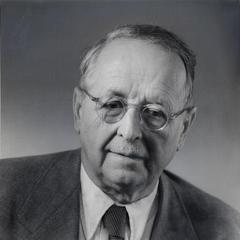
Hermann Weyl

Hermann Weyl Quotes

Mathematician

Filter quotes by topic

Famous Hermann Weyl Quotes

“The constructs of the mathematical mind are at the same time free and necessary. The individual mathematician feels free to define his notions and set up his axioms as he pleases. But the question is will he get his fellow mathematician interested in the constructs of his imagination. We cannot help the feeling that certain mathematical structures which have evolved through the combined efforts of the mathematical community bear the stamp of a necessity not affected by the accidents of their historical birth.”

“We are not very pleased when we are forced to accept a mathematical truth by virtue of a complicated chain of formal conclusions and computations, which we traverse blindly, link by link, feeling our way by touch. We want first an overview of the aim and of the road; we want to understand the idea of the proof, the deeper context.”

“A modern mathematical proof is not very different from a modern machine, or a modern test setup: the simple fundamental principles are hidden and almost invisible under a mass of technical details.”

“Our federal income tax law defines the tax y to be paid in terms of the income x; it does so in a clumsy enough way by pasting several linear functions together, each valid in another interval or bracket of income. An archeologist who, five thousand years from now, shall unearth some of our income tax returns together with relics of engineering works and mathematical books, will probably date them a couple of centuries earlier, certainly before Galileo and Vieta.”

“Not only in geometry, but to a still more astonishing degree in physics, has it become more and more evident that as soon as we have succeeded in unraveling fully the natural laws which govern reality, we find them to be expressible by mathematical relations of surprising simplicity and architectonic perfection. It seems to me to be one of the chief objects of mathematical instruction to develop the faculty of perceiving this simplicity and harmony.”