Quotessence
Home / Quotes / Quote by Jean Piaget

Quote by Jean Piaget

“The child who defines a lie as being a "naughty word" knows perfectly well that lying consists in not speaking the truth. He is not, therefore, mistaking one thing for another, he is simply identifying them one with another by what seems to us a quaint extension of the word "lie".”

Quote by Jean Piaget

Author
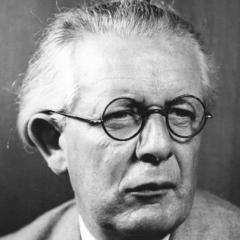
Jean Piaget
Jean Piaget

Swiss psychologist and the founder of the theory of cognitive development. Piaget's research has had a profound impact on fields such as educational psychology and child psychology. more

You May Also Like

“The need to speak the truth and even to seek it for oneself is only conceivable in so far as the individual thinks and acts as one of a society, and not of any society (for it is just the constraining relations between superior and inferior that often drive the latter to prevarication) but of a society founded on reciprocity and mutual respect, and therefore on cooperation.”

“It is as his own mind comes into contact with others that truth will begin to acquire value in the child's eyes and will consequently become a moral demand that can be made upon him. As long as the child remains egocentric, truth as such will fail to interest him and he will see no harm in transposing facts in accordance with his desires.”

“For the fundamental fact of human psychology is that society, instead of remaining almost entirely inside the individual organism as in the case of animals prompted by their instincts, becomes crystallized almost entirely outside the individuals. In other words, social rules, as Durkheim has so powerfully shown, whether they be linguistic, moral, religious, or legal, etc., cannot be constituted, transmitted or preserved by means of an internal biological heredity, but only through the external pressure exercised by individuals upon each other.”

“The relations between parents and children are certainly not only those of constraint. There is spontaneous mutual affection, which from the first prompts the child to acts of generosity and even of self-sacrifice, to very touching demonstrations which are in no way prescribed. And here no doubt is the starting point for that morality of good which we shall see developing alongside of the morality of right or duty, and which in some persons completely replaces it.”

“At one time, many philosophers held that faultless "laws of thought" were somehow inherent, a priori, in the very nature of mind. This belief was twice shaken in the past century; first when Russell and his successors showed how the logic men employ can be defective, and later when Freud and Piaget started to reveal the tortuous ways in which our minds actually develop.”

“Much research in psychology has been more concerned with how large groups of people behave than about the particular ways in which each individual person thinks... too statistical. I find this disappointing because, in my view of the history of psychology, far more was learned, for example, when Jean Piaget spent several years observing the ways that three children developed, or when Sigmund Freud took several years to examine the thinking of a rather small number of patients.”