“The human understanding is of its own nature prone to suppose the existence of more order and regularity in the world than it finds. And though there be many things in nature which are singular and unmatched, yet it devises for them parallels and conjugates and relatives which do not exist. Hence the fiction that all celestial bodies move in perfect circles, spirals and dragons being (except in name) utterly rejected.”
Quote by Francis Bacon
Work
New Atlantis and The Great Instauration
This book is a compilation of two seminal works that delve into the concepts of a perfect society and the pursuit of universal truths. The first part, 'New Atlantis,' is a fictional narrative that describes an advanced civilization with a focus on scientific inquiry and intellectual pursuits. The second part, 'The Great Instauration,' is a philosophical treatise that discusses the nature of reality, the existence of God, and the role of human reason. more
Author
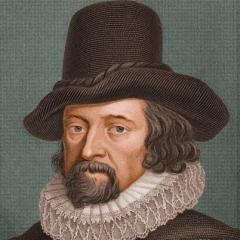
Francis Bacon
Francis Bacon, a renowned philosopher, politician, and writer, served as the Lord Chancellor of England. He is best known for his profound philosophical thoughts and extensive literary works, which have had a lasting impact on the world. more
You May Also Like
Source: Tobaccoism;: Or, How Tobacco Kills,
Source: A System Of Logic, Ratiocinative And Inductive: Mill's Works
Source: A System of Logic, Ratiocinative and Inductive: Being a Connected View of the Principles of Evidence and the Methods of Scientific Investigation
“What is there in a name? It is merely an empty basket, until you put something into it.”
Source: Passages from the Life of a Philosopher
Source: Pocket Aristotle
Source: Experimental Medicine
“He best keeps from anger who remembers that God is always looking upon him.”