Quotessence
Home / Quotes / Quote by Lawrence Lessig

Quote by Lawrence Lessig

Work

Free Culture: How Big Media Uses Technology and the Law to Lock Down Culture and Control Creativity

This book delves into the strategies employed by large media corporations to restrict access to cultural content and maintain control over creative expression. It examines the intersection of technology and law in shaping cultural landscapes and the implications for individual creativity and societal values. more

Author
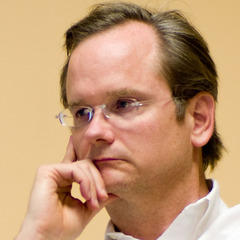
Lawrence Lessig
Lawrence Lessig

Lawrence Lessig is a distinguished political activist and legal scholar, recognized for his work in intellectual property law, copyright, and governance. He has been a professor at Harvard Law School and is the founder of the Creative Commons movement. more

You May Also Like

“Creativity builds upon the public domain. The battle that we're fighting now is about whether the public domain will continue to be fed by creative works after their copyright expires. That has been our tradition but that tradition has been perverted in the last generation. We're trying to use the Constitution to reestablish what has always been taken for granted--that the public domain would grow each year with new creative work.”

“When you think about a presidential candidate spending all of his or her time talking to that tiny, tiny fraction of us who have the capacity to fund political elections, it's obvious why the perspective of government is skewed relative to what most Americans care about.”

“The crystal ball has a question mark in its center. There are some fundamental choices to be made. We will either choose to continue to wage a hopeless war to preserve the existing architecture for copyright by upping the stakes and using better weapons to make sure that people respect it. If we do this, public support for copyright will continue to weaken, pushing creativity underground and producing a generation that is alienated from the copyright concept.”

“The more important point, however, is not about what the money does. It's about what has to be done to get the money. The effect of the money might be (democratically) benign. But what is done to secure that money is not necessarily benign. To miss this point is to betray the Robin Hood fallacy: the fact that the loot was distributed justly doesn't excuse the means taken to secure it.”

“There are a lot of people who say we need to cut the amount of money that's spent in politics. I'm not sure that I agree. But I am sure that if you were talking about cutting the amount of money spent in politics, the media would have a strong interest in opposing you, because they make an enormous amount of money from political advertisements.”