Quotessence
Home / Quotes / Quote by Lawrence Lessig

Quote by Lawrence Lessig

“The more important point, however, is not about what the money does. It's about what has to be done to get the money. The effect of the money might be (democratically) benign. But what is done to secure that money is not necessarily benign. To miss this point is to betray the Robin Hood fallacy: the fact that the loot was distributed justly doesn't excuse the means taken to secure it.”

Quote by Lawrence Lessig

Author
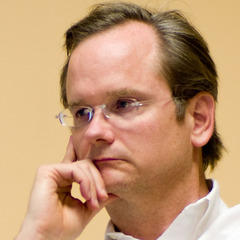
Lawrence Lessig
Lawrence Lessig

Lawrence Lessig is a distinguished political activist and legal scholar, recognized for his work in intellectual property law, copyright, and governance. He has been a professor at Harvard Law School and is the founder of the Creative Commons movement. more

You May Also Like

“There are a lot of people who say we need to cut the amount of money that's spent in politics. I'm not sure that I agree. But I am sure that if you were talking about cutting the amount of money spent in politics, the media would have a strong interest in opposing you, because they make an enormous amount of money from political advertisements.”

“As more and more citizens express what they think, and defend it in writing, that will change the way people understand public issues. It is easy to be wrong and misguided in your head. It is harder when the product of your mind can be criticized by others. Of course, it is a rare human who admits that he has been persuaded that he is wrong. But it is even rarer for a human to ignore when he has been proven wrong. The writing of ideas, arguments, and criticism improves democracy.”

“I think the reality is that copyright law has for a very long time been a tiny little part of American jurisprudence, far removed from traditional First Amendment jurisprudence, and that made sense before the Internet. Now there is an unavoidable link between First Amendment interests and the scope of copyright law. The legal system is recognizing for the first time the extraordinary expanse of copyright regulation and its regulation of ordinary free-speech activities.”

“There is a regulation of behavior on the Internet and in cyberspace, but that regulation is imposed primarily through code. The differences in the regulations effected through code distinguish different parts of the Internet and cyberspace. In some places, life is fairly free; in other places, it is more controlled. And the difference between these spaces is simply a difference in the architectures of control--that is, a difference in code.”

“We live in a world with "free" content, and this freedom is not an imperfection. We listen to the radio without paying for the songs we hear; we hear friends humming tunes that they have not licensed. We tell jokes that reference movie plots without the permission of the directors. We read our children books, borrowed from a library, without paying the original copyright holder for the performance rights.”

“A free culture supports and protects creators and innovators. It does this directly by granting intellectual property rights. But it does so indirectly by limiting the reach of those rights, to guarantee that follow-on creators and innovators remain as free as possible from the control of the past. A free culture is not a culture without property, just as a free market is not a market in which everything is free. The opposite of a free culture is a "permission culture" -- a culture in which creators get to create only with the permission of the powerful, or of creators from the past.”