Quotessence
Home / Quotes / Quote by David Hockney

Quote by David Hockney

“Modernism in a way, early modernism, for instance, in pictures, was turning against perspective and Europe. And all early modernism is actually from out of Europe, when you think of cubism is African, is looking at Africa, Matisse is looking at the arabesque, Oceania. Europe was the optical projection that had become photography, that had become film, that became television and it conquered the world.”

Quote by David Hockney

Author
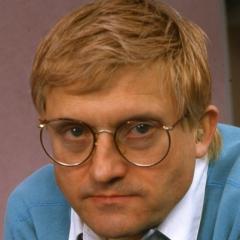
David Hockney
David Hockney

David Hockney is a renowned British photographer, born on July 9, 1937. His works are known for their unique perspective and color application, which have had a profound impact on the development of photographic art. more

You May Also Like

“I felt that there's an obligation when writing a piece about an urban expressway made in the 50s to acknowledge the context, and Robert Moses is sort of an iconic figure in New York, and he influenced the shape of the city more than anyone else before or after him. He was one of the most powerful and influential civic architects in the world, because of how much he transformed the city. He built multiple bridges and highways and parks and recreational spaces, beaches - in the course of a few decades, he completely changed the city”

“I have a lot of friends who have hula-hoops, it's like a mixture of dance and athletics and exercise, meditation. It's a healthy hobby I think. I can do a few tricks, I can hoop from my neck and shoulders, and I can do a few moves, a few tricks! I can walk through the hoop whilst it's spinning. I feel like there's definitely an interest in promoting the hula-hoop as an important pastime!”

“I think that music has always been restricted to media. The LP is an antiquated form, and the CD is now an antiquated form, and there's no sense grieving. Music is forever, there will always be songs. It's exciting that we're not limited to the media any more. I don't hold a precious view of my work, that it exists outside of social constructs or the confines of a platform.”

“I'm no longer beholden to the sacredness of the recorded song as some kind of ultimate standard by which every performance of the song is measured. I like to diversify, that there are multiple versions of every song. And the songs incorporate a lot of improvisation, and an element of chance, and I think that's exciting. There's no one true formulation of a song, they have various manifestations depending on the space we're in. I like that.”

“I'm not beholden to the public, and neither are the public beholden to me or my songs. I'm very much of a populist on those terms, I believe that the song is no longer mine anyway. I like to process the dispossession that happens when you play something live. I don't have a clue as to how these songs are going to plan out, whether they're going to be on a record. I don't know yet.”

“In the 80s, if you wanted to make electronic music, it was a much tougher and more expensive process. For many people it would involve either spending loads of money on gear or else cutting demos in a proper studio. But I had this Casio keyboard and tape recorder and used to do stuff in my bedroom - I'd listen to Mantronix and all that. That was what I had so that's what I used.”