Quotessence
Home / Quotes / Quote by Marquis de Sade

Quote by Marquis de Sade

“Self-interest lies behind all that men do, forming the important motive for all their actions; this rule has never deceived me”

Quote by Marquis de Sade

Author
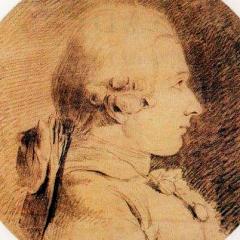
Marquis de Sade
Marquis de Sade

Marquis de Sade, born on June 2, 1740, and died on December 2, 1814, was a prominent French philosopher and writer of the 18th century. He is known for his profound reflections on freedom, morality, and human behavior. more

You May Also Like

“There is only one sin, only one, and that is theft. Every other sin is a variation of theft. When you kill a man, you steal a life. You steal his wife's right of a husband, you rob his children of a father. When you lie you steal someone's right to truth. When you cheat, you steal the right to fairness. There is no more wretched act than stealing. A man who takes what is not his to take, be it life or a loaf of naan, I spit on such a man. And if I ever cross paths with him, God help him.”

“A higher understanding of human freedom, however, is inseparable from a definition of human nature. To be free is to be able to flourish as the kind of being one is, and so to attain the ontological good toward which one's nature is oriented; freedom is the unhindered realization of a complex nature in its proper end (natural and supernatural), and this is consummate liberty and happiness. The will that chooses poorly, then - through ignorance, maleficence, or corrupt desire - has not thereby become freer, but has further enslaved itself to those forces that prevent it from achieving its full expression. And it is this richer understanding of human freedom that provides us some analogy to the freedom of God. For God is infinite actuality, the source and end of all being, the eternally good, for whom mere arbitrary 'choice' - as among possibilities that somehow exceed his 'present' actuality - would be a deficiency, a limitation placed upon his infinite power to be God. His freedom is the impossibility of any force, pathos, or potentiality interrupting the perfection of his nature or hindering him in the realization of his own illimitable goodness, in himself and in his creatures. To be 'capable' of evil - to be able to do evil or to be affected by an encounter with it - would in fact be an incapacity in God; and to require evil to bring about his good ends would make him less than the God he is. The object of God's will is his own infinite goodness, and it is an object perfectly realized, and so he is FREE.”

“Where would the end be? Will the idea—the definition—of perfection stay the same? No. Perfection is too fickle. It’s in our nature to never be satisfied. We always think we can do more.”